I am back again with another “invention”! This time it’s something I’ve started calling puzzle stories. It’s an idea I’ve had for years, but I always failed to find the time or the right theme.
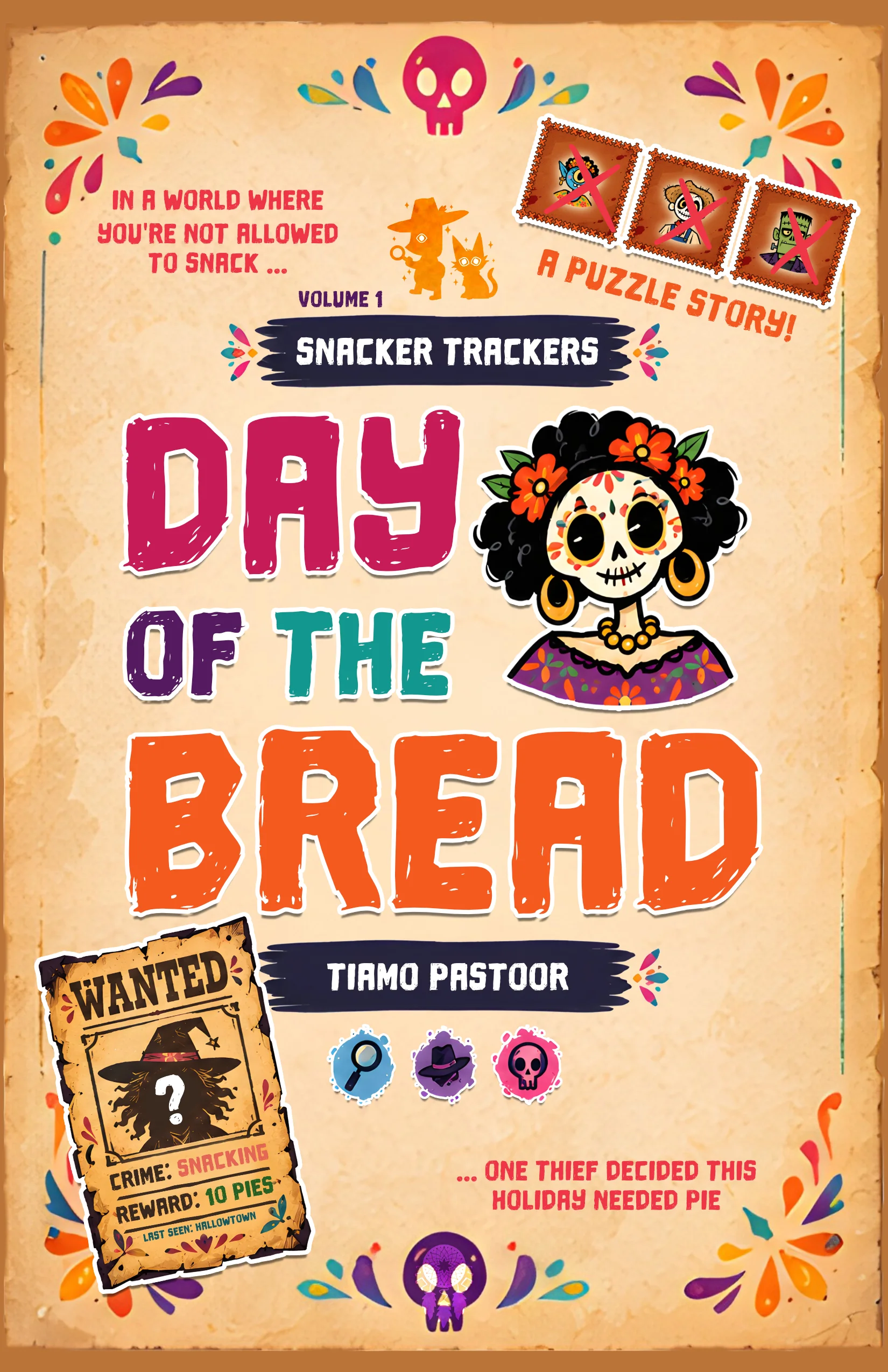
Some weeks ago, things came together nicely and I went for it! The result of this work is the very first “Snacker Tracker” story, themed around Halloween (Oct 31) and Day of the Dead (Día de Los Muertos, celebrated Nov 1-2).
You can buy Day of the Bread in Paperback (Color!) or Ebook format. For my Dutch readers, here’s a better link, though the story is still in English.
What’s the idea?
The book starts with a “crime” that you need to solve. In the Snacker Tracker fantasy universe, all tasty food has been forbidden, so a crime usually just means … baking a pie or eating a snack ;)
The book also starts with 36 portraits of characters: they are your “suspects” (and you will meet many of them in the story).
Every chapter in the story contains a clue about which characters you can eliminate. At the start, clues are obvious and easy. The final chapters might require one or two extra steps, or ask you to remember some information from before.
When all is said and done … you will have eliminated all but one suspect. They must be the criminal!
This book combines reading with puzzling. It provides a way to figure out who did it yourself—for sure—just before it’s revealed at the end of the story. It’s a new exciting way of creating books, if I may say so myself.
Why did I make this?
It’s hard to make children excited to read. Especially with screens draining their attention all the time. And so I thought: how can we make a story visual and interactive? And how can we do it while still keeping it a story/book?
I have several ideas for this, but this one felt like it was the strongest.
I can write a proper story in this format. Characters, emotional moments, tense action scenes, a proper novel. Nothing gets in the way of that.
At the same time, children are always looking for that next clue and want to figure out who did it. Even children who struggle with reading can focus on that part of the book and enjoy it. This not only trains language comprehension, but also logical thinking, mathematics, and more.
Because the story starts with this nice wall of suspects, it’s much more approachable. Kids are visually interested immediately. They can see the characters they will be meeting in the story, which helps paint a picture.
These kind of “puzzle stories” didn’t just feel easier to read, they are also more educational. I’ve been writing educational stories for years now for The Wayward Melody and intend to keep doing so. Snacker Trackers are a great entry to that list.
As for myself, the writer, this setup also made the most sense. Having this “requirement” that every chapter provides a clue that removes 3–5 suspects is great for focusing and making decisions. It helps me to write quickly and keep moving, as I always have a nice target to go for.
In the end, this first book actually has a really nice emotional story too. I’m proud of both the puzzle and the story, and they combine flawlessly, which helped make this the fastest project I’ve ever finished. (Of this size, at least: it’s 110+ pages, 10 chapters, fully illustrated.)
I’ve already started on several more Snacker Trackers. Using the lessons learned in this one, I think I can make the puzzle and story even better and more educational.
If you check it out, let me know what you think!
Until next time,
Tiamo