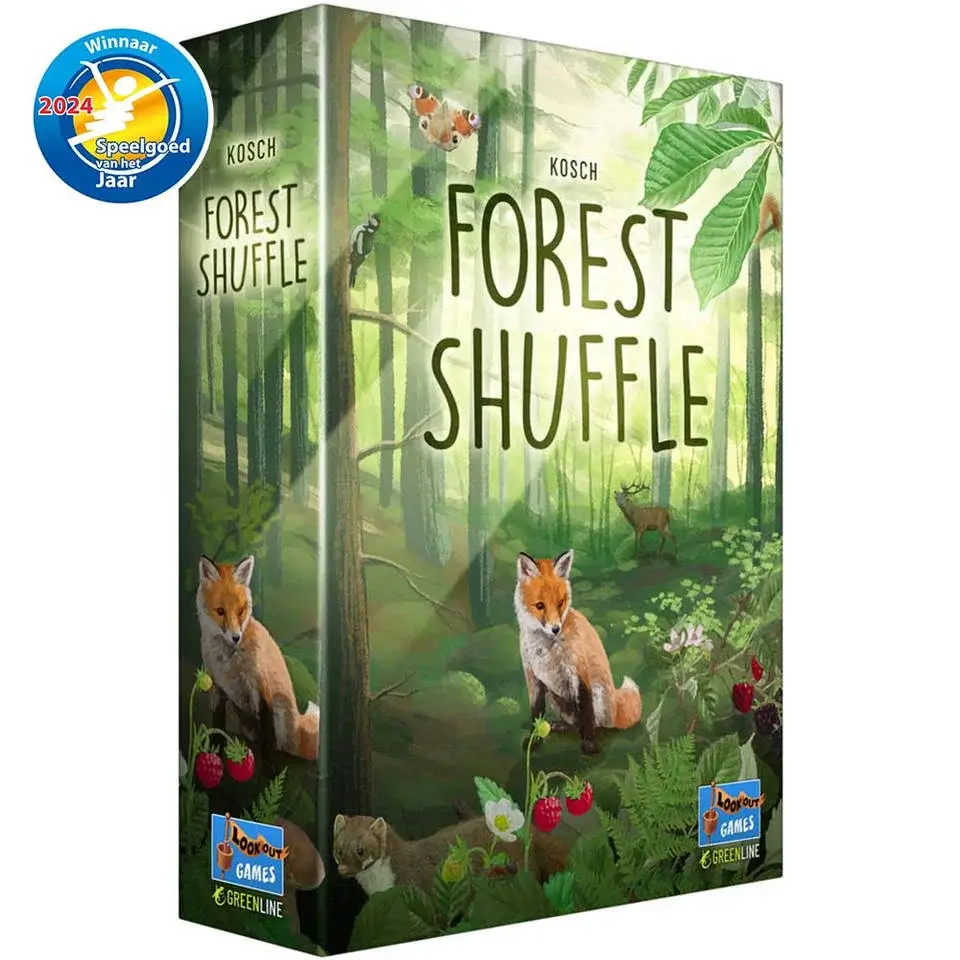
This is a short article with my thoughts about the board game Forest Shuffle. I haven’t played it enough to give a “full review” or deeper thoughts. In fact, I only played it accidentally because my mother bought it on a whim—she likes forest and nature themes—then suddenly asked me to read the rules and explain the game.
In any case, we played it, and I had some thoughts!
What’s the idea?
First of all, it’s a good game! Once you’ve played a round or two, everyone gets into the flow of things, and it’s an interesting puzzle all the way through.
The core idea is really clever and works even better in practice. There are only two types of cards: trees and animals. Trees can be played on their own, somewhere in front of you. But animals must be played to a tree (either left/right/up/down). Animal cards have two sides, so only the side that’s actually showing (and not covered by the tree after placement) counts. It’s a very simple but tangible idea that automatically leads to interesting choices and a nice forest in front of you.
As expected, you score points for all sorts of “synergies”: animals that want other animals in the same tree, animals that multiply if you also have their prefered food source, etcetera. This is a nice way to actually simulate the natural theme and it’s also always satisfying to discover combinations like these in games and try to pull them off.
That said, the explanation of the game and the first few rounds were a big struggle. And that’s a shame, because it’s really not a hard game, and it didn’t have to be this way. In fact, before I arrived, my younger sister had already read the rulebook and tried to teach it, but there was too much confusion. Then I had to step in, very quickly read the rulebook, and do a second explanation … and still the players were a bit confused on their first turns.
Why? What can we do about that? I really believe this is a great lightweight game that any family can play, but the initial rule dump is clearly too big of a hurdle.
How To Teach The (First) Game
So, being a game designer myself, I thought about it some more. And now I will list how I would simplify this game so it’s easier to teach and get into that first game.
- Leave out the “Cave”. There are just a handful of animals in the game that say “put cards into your cave”. It’s a cool element of the game, but absolutely not crucial. (In fact, it’s slightly overpowered, more on that later.) If you leave them out, you can also forego giving everyone a “cave” card, and it just streamlines that first game.
- Leave out the “bonus” (the binoculars icon). Again, this is a nice part of the game, but not crucial. In our first game, we only got a bonus a handful of times, and the reward itself was slightly disappointing in many cases (if you ask me). In return for that mechanic, though, you need to explain a whole extra subsystem of the game. For a first game with newbies? With young kids or your mom and dad? Just ignore it.
- Trim the deck slightly more. Our first game took well over 2 hours. Dinner and everyone’s schedules were delayed because of it :p A first match of any game, in my opinion, should never run longer than 45-60 minutes. Because you’re still learning the game, you’re stumbling around, you can’t think long-term yet. There’s no point playing the “full game” when you have no clue what is on all those cards.
- Make the ending more predictable. Cut the deck into 4 or 5 equal parts, then simply shuffle a single Winter card into the bottom one, then combine them all into a single deck again. Now you can simply say “Winter arrives somewhere near the end of the deck. And when it does, the game is over!”
- Leave out any “permanent effects” (Mushroom icons): As before, only a tiny subset of the cards have one. But it requires extra explanation (“another exception”), and new players are likely too busy understanding the game to actually remember they have the power.
- OPTIONAL: Ignore the “play a tree, add an extra card to the board” rule and trim the number of trees in total. This is another little extra exception that took players a looong time to remember and internalize. I can see why it’s there: otherwise the game can grind to a halt if everyone is just adding more trees to their forest. But that’s not really relevant for a first game. In my experience, there are already too many trees in the deck anyway and most are never played.
With these small changes, you’ll get a first game that has a much easier “teach” (fewer rules, streamlined, no exceptions, nothing else to remember) and will end faster. At least, that’s how I feel right now.
My Specific Issues With It
These “simplifications” I suggested in the previous section already touch on all my criticisms of the game.
- The “Cave” mechanic is interesting, but way overpowered (“swingy”) when players are inexperienced. For example, one animal allows you to take all cards in the clearing and put them in your cave—that’s 10 points for free in one turn. Unless other players know this card exists and actively keep the clearing more empty. Then I can see the idea being balanced and all. But as you can probably tell, someone won our first game off of two massive point waterfalls from Cave abilities that we had no idea even existed (and had no power to stop). Though, there was a second reason they won …
- The game rewards a single tunnel vision strategy over diversity. In general, I don’t like this, because it feels like I can’t be creative and really play with my own strategies. For a game about nature and diversity, this felt like the wrong choice. The second thing that our first-game winner scored on were the Butterflies. They just got lucky and all 5 variaties just ended up in their hand: that’s 100 points for free. (Besides Cave + Butterflies, this player barely scored anything else. And yet they won handily.)
- I don’t want a game to just be “pick the one thing you will do at the start, then do that the whole game”. Oh, you started with a Butterfly? Guess it’s a Butterfly game for you and that’s that! I want more diversity, more interactions, more variety than that.
- Admittedly, this was also my own fault. I tried to diversify, but ended up with “meh” bonuses on the five or six different combos I went for. So this is partly a criticism, and partly just a learning experience that I’ll take to my next games!
- I don’t like the Winter mechanic. I understand completely why it’s there. The three cards give you a warning that the game might end soon. At the same time, you have that uncertainty, a bit of a luck factor, and a reasonable simulation of what happens in nature too. But … the scoring in this game depends so heavily on finishing some massive combo. It doesn’t feel fun if the winner is decided by when exactly that Winter card arrives in that final round. It doesn’t feel fun if the only reason you did not get to score those +25 points you’ve been aiming for all game, is just pure chance and the previous player deciding to draw cards because they had nothing better to do.
- Why are there so many trees!? This game is really “tight”. Each turn you either play one thing, or draw two things, that’s it. No choice to draw more cards, or play more, or discard stuff you don’t want. In such a game, it doesn’t feel great when all your options are just all trees. (Sometimes even all trees of the same type!) Nobody needs more trees, nobody is grabbing them, so they’re just staying in the clearing forever. This basically reduces your options to “hoping for an animal” or “guess I’ll do that one animal I have in my hand”.
There are expansions for the game. Maybe they add more animals, more diverse strategies, more synergies, fixes to these issues. I also wouldn’t have minded a version of the game without (tiny) text on the cards. Using just a few simple icons and repeated synergistic actions would make the game look far less intimidating and make it more accessible, also perhaps as an educational game.
But I’m reviewing the base game here, so I’m going off of my experience with that.
Conclusion
All in all, Forest Shuffle is a great game for all ages that looks nice and plays with quick turns.
Without some modifications, however, explaining the game is much harder than it needs to be, and playing that first game will take much longer (and be a bit more frustrating) than it needs to be.
The core concept of playing trees and then having to play animals to those trees (left/right/up/down) is simply genius and creates a nice puzzle from start to finish. If you focus on that, and that alone, then the game is very quick to teach and easy to just start playing. Each turn is just one choice (“DRAW 2 or PLAY 1”), which means it’s quick and snappy. It doesn’t lead to “analysis paralysis”, I’ve noticed, unless you have a hand full of complicated animal actions. (Which is why I suggest leaving those out in a first game.)
Those were my thoughts for today,
Pandaqi / Tiamo