It’s been a while since I read the books and watched the show for His Dark Materials. It was a story with several really strong ideas and a strong conclusion, but a somewhat vague and uninteresting connective tissue between those moments. I didn’t really know what to say or think about it.
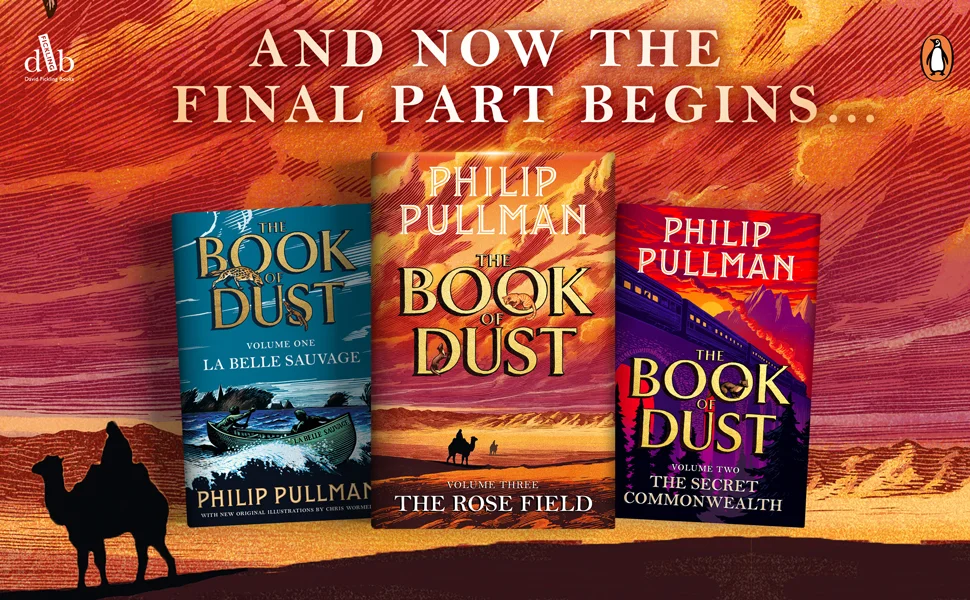
Then I learned Philip Pullman (the writer) was writing a sequel trilogy: The Book Of Dust. At the time, he had finished the first two books, but there was no clear date on the third yet (due to health issues it seems). I read the first book, took a break, then read the second, then forgot about the trilogy. I only recently remembered the third book (which had finally released!) and finished it.
And I felt much the same way about these books as I did about His Dark Materials.
Now you know the two reasons why this review will be rather short and vague.
- I just don’t know what to say about these unique stories or what to think about them.
- There have been pretty long gaps between my reads, causing me to forget most of what came before.
I just don’t know many details anymore and I’m honestly not interested enough in the world/story to dig deeper on a lot of things. I guess that already gives you the summary of my review: The books are fine—sometimes great, sometimes slow and vague—but never really interested me or made me eager to continue reading.
It’s the same as always. If something is really good, I’ll make an effort to finish the books (and perhaps write a review) more quickly. If it’s just mediocre, I’ll eventually finish it and give my thoughts, but there’s obviously no hurry. These books are in some weird twilight zone where you can see they are not bad and appreciate some cool stuff it tries to do, but you can’t honestly say it was ever really interesting or extremely well-written or made you eager to continue.
There are no real spoilers in this article. Just very light spoilers, if you think about them too long, for both His Dark Materials and Book Of Dust.
The Pullman Problem
Having read six long books from this author, I clearly see a pattern.
- He desperately wants to infuse his stories with some much deeper layers, meanings, philosophies.
- But he uses only two ways to get there: either be extremely obvious and on-the-nose, or be so vague and philosophical as to not actually including anything at all.
The strength of his books comes from their premise. The idea of creating openings between worlds. The idea of having a daemon with you. The idea of there being something called Dust that you can photograph if you know how, that appears much more near adults, that has some mysterious meaning. Even the idea of a twisted version of Britain where everything is just a little different and somehow more cozy.
I feel like His Dark Materials had the stronger premise(s) and actually explored it and made it go somewhere. A large part of the story is dedicated to learning how to create openings, how to “use” them properly, but also resolving into a bittersweet ending because of all that.
I was, however, repeatedly disappoint by big ideas and interesting premises not really going anywhere in The Book of Dust. Did it give me any new insights or things to chew on? Did it show, through the story, some of its themes or philosophies? No, not really.
There are countless unrealistic dialogue scenes in which characters literally state the big lesson you have to take away, saying it to each other’s face. So many conversations are—I am not exaggerating—as follows,
- A: “Question?”
- B: “No idea. Random other question?”
- A: “Not sure. Random other topic?”
- B: “Don’t know. Come on, we need to move.”
And then there are scenes that I assume were put in to show these ideas, because they otherwise feel very random and uninteresting, but I didn’t really get anything out of them.
In The Book Of Dust, for example, it introduces some interesting ideas.
- The first book shows us the Great Flood and how Lyra ended up at Jordan College because of it. (Which is the point where both the books and show of His Dark Materials kind of start the narrative, but never properly explain it.)
- It introduces a mysterious Red Building in the desert that’s so important that it’s heavily guarded and you can’t enter with your daemon.
- It introduces Rose Oil, coming from that building, which allows you to see Dust.
- It introduces the idea that modern times made us too practical and efficient, losing our imagination and playfulness, which is then reflected in our daemons separating/dying/being unhappy.
There are questions to which you want answers. There are clear goals, such as “get to the Red Building and see what it is”. There’s a strong idea that can lead to a strong book.
But the execution feels meandering, aimless, uninteresting. As I said, the writer seems to have only two writing modes. Either something big suddenly happens (without feeling like you know why, or you had any build-up), or nothing happens at all while people literally state what the author wants you to know right know.
At no point did I have any clue where the story was going at all. Why characters were there and what their goals really were, or what their arc might look like. Why we were suddenly doing this one thing for many chapters. When the story was over, I shrugged and thought “that was an ending”. Almost no questions answered, we’re in mostly the same place as before, while our main characters are just flat-out making hard to parse statements about Dust.
Is this bad storytelling? Is it just personal preference? I don’t even know. All I know is that it wasn’t very interesting to read. It never felt like there was payoff or reward for what came before. It never felt like I could connect to any character. All of them seem cold, just pieces on the board to make the plot happen. A beloved witch just dies offscreen (or rather “offpage”), handled by a few lines of cold dialogue.
It never felt like anything … went anywhere. You ask yourself “what was the point?” For days, after finishing the trilogy, your brain keeps remembering other names and plot threads and mysteries and ideas that were thrown into the air at some point … and just never landed. Forgotten about, it seems.
In a way, it’s a real skill to still get a full book out of that (which I finished reading). Maybe it’s just his writing style. I feel like the same ideas and premise would lead to a completely different story if anyone else had written it—either more “fantasy” or more “grim (family?) drama”. I feel like the author always puts himself into a problem I’ve encountered numerous times too: you have an overall abstract idea for a story, but you struggle immensely to actually turn it into specific beat-by-beat story events.
He probably thinks “Let’s explore imagination” and then struggles to come up with how to structure the specific story to do so. (As opposed to coming up with interesting story and finding/crafting the theme and deeper meaning later, which is much more natural and what most writers do.)
I hope this doesn’t read as a bashing of this particular author. I’ve literally read all his major works, I clearly don’t think he’s bad ;) It’s just a recurring pattern that I wanted to analyze.
I just feel like there should have been a more action-packed and deeper way to explore the interesting ideas. To have a fast-moving plot with clear goals and trajectories, while showing your philosophical topics instead of doing random stuff and then just talking about your message once in a while.
The First Book Is The Best
For exactly that reason (see previous paragraph), I believe the first book was the best.
The Great Flood creates clear plot. It creates momentum, and action, and a clear goal, which becomes a skeleton around which you can build the rest of the story. (In that book, Malcolm ends up taking Lyra to Jordan College in his canoe, because, well, everything is flooded and dangerous.)
The first book actually answers mysteries. It introduces interesting things that are then resolved or progressed. It still has a lot of these “Pullman” moments in which the story meanders and has unrealistic philosophical dialogue, but they actually have their place and they are fun to read because of the overall story momentum.
And Malcolm Polstead is a great character. He is capable, even as a very young kid, which is something we don’t see often enough in stories anymore. He is completely kind-hearted—but knows when to lie, cheat, or do what’s needed to solve a problem or get out of a situation. You want to follow a person like that and see him take Lyra to safety during a freak weather event.
The later books lack this clear structure for the story. Lack clear goals and trajectories, characters that receive depth and warmth, lack a proper resolution to the sometimes pretty random events and dialogues you’ve been reading for hundreds of pages. (I will make an exception for Abdel Ionides, he was a fun and well-defined character.)
I feel like these books are dangerously close, all the time, to being just a chain of events rather than a story. A lot of random stuff happens. And it decides the random stuff that happens next. As opposed to action and reaction or cause and effect—as opposed to characters constantly making decisions that shape the story. Which is how you get to an ending after a thousand pages, and you feel like the ending could have been literally anything else and it would fit just as well.
A lot of the time, these books take the longest way around to make something happen that the author needed to happen. As an author, I am quick to notice author’s maneouvering behind the scenes to place specific pieces to have a plot make sense. You get a sort of sense for when something just had to happen in this way, otherwise what came before/after would be unbelievable or illogical. A good story manages to make these events interesting and organic too. But in an attempt to do so, these stories come up with these elaborate new locations/schemes/side quests all of a sudden, which makes the story feel slow even if a lot is technically happening.
Dust? What’s Dust?
When you title a trilogy Book of Dust, I kind of expect to get a lot of exploration and answers about that mysterious Dust. And it seems like the books were headed that direction too, at the start. Maybe that was the plan but it didn’t work out in the end.
Because, in the end, we barely learn anything new. The few bits of progress are either undone by the end or amount to nothing more than a … name change.
This, again, feels like a wasted opportunity. Wasted by someone who clings to some abstract philosophical idea the story needs to consider, instead of putting story first. Dust is the ideal way to make something abstract visual, physical, tangible. You can use the Rose Oil to let character see Dust all around them, and they could notice it in very odd places, and they could investigate that. You get plot and a proper exploration of what Dust is and its mysteries.
I feel the lack of updates or answers on Dust just underlines how few things in this story went anywhere or had any payoff. Even as I write this review, a hundred things come to mind that happened in the story and had no follow-up or resolution. A hundred things that got a lot of time and attention, but I was at best only mildly interested when reading about them, and now I realize they had no point being in the story at all.
Conclusion
I wish I could go into more detail, but that’s all a bit fuzzy in my memory. (And I never want to add spoilers to the first section of a review article in any case.)
I also wish I could say more positive things about these books, but I really can’t. Hopefully I was able to articulate why the books never really worked for me and why I struggle to say anything about them at all.
I would recommend these books only to fans of the universe, or a very specific kind of reader that’s fine with just floating along with an aimless story. Otherwise I think there are better explorations of the same themes that actually have meaningful and streamlined plots.