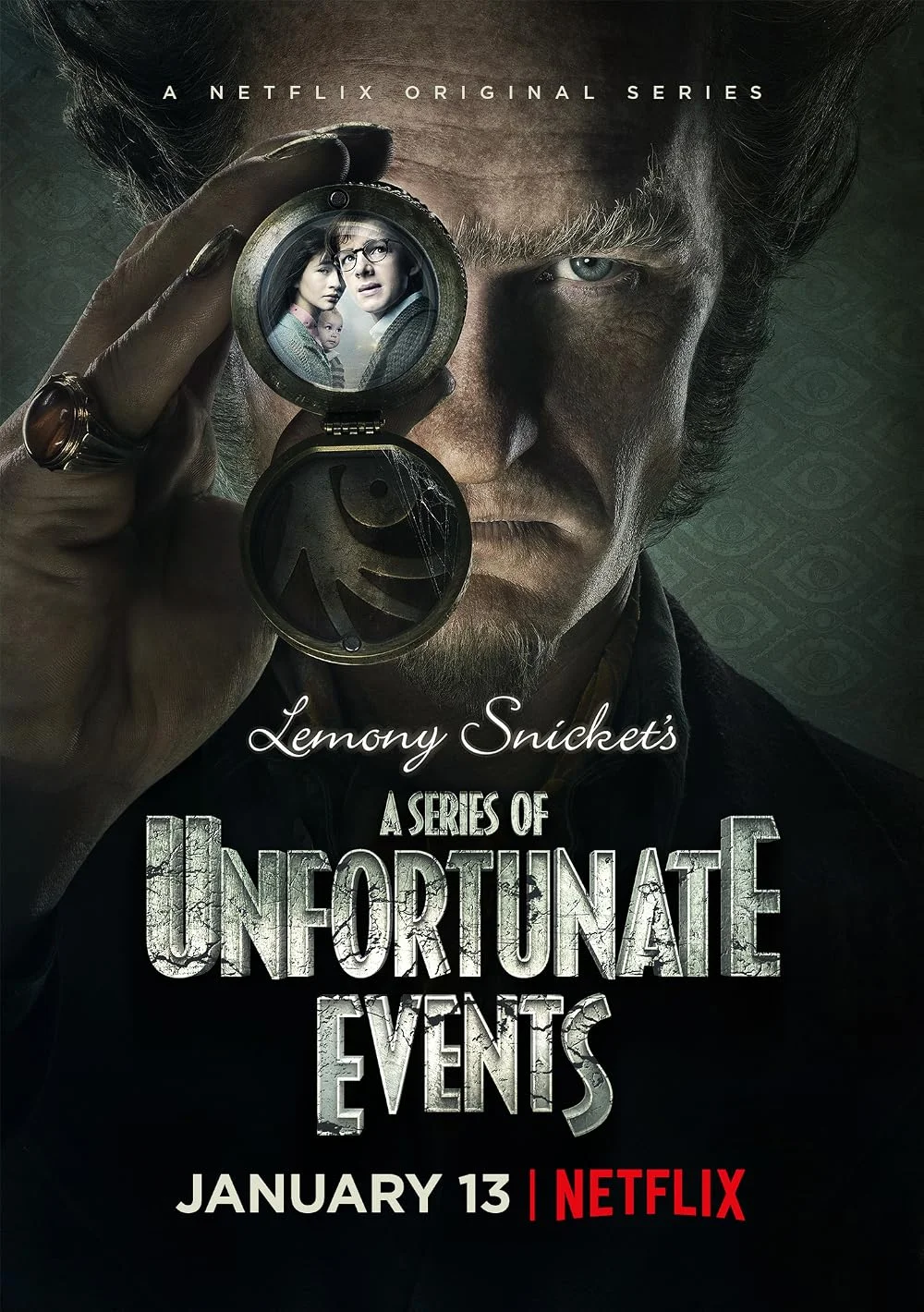
Almost two years ago now, I finished reading all the books of A Series Of Unfortunate Events and wrote a review about them. I promised to watch the Netflix show soon, to compare them and give my thoughts. As an author myself, I always like to read the books first and then watch the adaptation, because there’s a lot to learn from how stories are streamlined or improved for a different medium.
Well, erm, it took a while, but here were are!
I actually saw the first season of the Netflix show right when it came out. I watched it with my sister, with whom I watched a lot of series and films back then. That is to say: it was more a habit than a desire to watch this show specifically. (We also watched Avatar, Doctor Who almost in its entirety, all the Marvel stuff until Infinity War came out, and so forth. Man, that feels so long ago …)
We never watched later seasons, I believe, because we simply weren’t interested enough. The show had the same problem as the books: it’s mostly interesting because of wacky guardians (funny and interesting new situations each time) and the big mystery (of the secret organization). As the series goes on, the situations become less and less rich and interesting, while the big mystery remains a big mystery because you never actually learn anything worthwhile.
When I started watching the show again, right after finishing the books, I basically came to the same conclusion again. I watched the first part of the show right away, but it took a year before I found the motivation to properly watch the later half. That’s why this “review” is much delayed. And also why it will be longer than expected, because I’ve gathered a lot of thoughts on this show and story over the years ;)
If you want the short answer: The series is a great adaptation, pretty different from anything else, and more coherent/consistent than the books. But it’s not AMAZING because it fails to improve on the many shortcomings of the (later) books. Enjoyable enough and the best one could have hoped for, I guess, but also frustrating and full of of missed opportunities.
As an adaptation of the books, though, it’s pretty much spot on. The tone, the vibe, the visuals, how they decided to translate it all, I can’t think of any project that adapted a story/book better (and more faithfully) than this one.
But let’s not get ahead of ourselves. Let’s dive into my thoughts one by one.
Good Thing: More Coherent Story
It really does feel like the author actually knows what the story is supposed to be now, after writing all the books. Introducing the secret organization and extra characters/plots right from the start adds a lot of momentum and consistency. Slight references or foreshadowing also works much better this way. There’s more humor in this version of the story, and things can be slightly more fleshed out.
The show introduces some extra characters. Or gives existing characters much more time/background (such as Olivia Caleban) and keeps them on for a while, instead of suddenly adding a new volunteer in every book that comes out of nowhere and barely gets any depth. There are also some revelations about the mystery that are made more explicit, or repeated, perhaps to ensure viewers really understand.
Though there are also many book events they completely changed/removed and I don’t see a good reason why. Might just be the physical/real-life constraints and complexities of shooting something as ambitious as this. I’ll get into that later.
Example Of More Complete Writing
The entire “hypnosis” angle of the fourth story comes out of nowhere (and doesn’t really fit the rest of the series) in the books.
In the show, this is actually set up, with a quick background on Olaf + Orwell, and a hint that the workers are hypnotized when they give machine-like responses to certain questions. (Like “if it’s so miserable here, why don’t you leave?”)
We even get more snippets about how Olaf tracks them down each time. How he keeps finding the Baudelaires and being in the right place, which was sorely missing from the books. All of this takes only a few minutes at most, in total, but it does so much for having a story feel more complete and coherent.
Though this also gives an example of changes they made that I don’t understand. Why have the children leave for Lucky Smells Lumbermill of their own accord? (In the books, it’s just the next place they’re sent by Poe.) They add this fake rumor about their parents burning down Paltryville just so they have a “reason to stay”, which feels very flimsy and forced. Yes, it adds a tiny extra bit of tension and plot progression. But it wasn’t really a necessary addition, and it would not have been needed at all if they hadn’t made that first change of having the children leave!
At first, I suspected this change would allow Poe and his wife to keep more relevancy into the next seasons. In the books they kind of just disappear and are forgotten. This way, however flimsy the excuse, they could keep trying to find the Baudelaires/keep their job for a few more episodes. But then! At the end of Season 1, Poe finds them again and we’re back to the books anyway! So what was the point?
Unfortunate Thing: Wordy Dialogue
The dialogue and pacing could be slightly sharper.
In general, the pace is quite good and consistent, but there’s some unneeded repetitiveness and some things that just go on too long (like a joke that goes on slightly too long or gets slightly too much of a pause after it).
Mostly, I would’ve liked just a bit extra sharpness in the writing itself, to make sure scenes are played out to their fullest extent (in terms of intrige/humor). There’s a certain wordiness to a lot of it, like Klaus or Violet just saying these awfully long and complicated sentences all the time.
Things are often stated twice, or very explicitly to the point it does not feel like anything anyone would ever say. Maybe this is to help younger viewers understand, but I don’t remember the books really doing this, and I don’t think the story is anywhere near “complicated” enough to warrant this.
At many points, there’s just so many words being said so quickly that I could barely follow with subtitles. And as my remark/example showed, it’s not that hard to shorten any dialogue or cut it up into something more realistic and flowing.
Oh, another example I just remembered: “Wait until the readers of the Daily Punctilio hear about this!” Poe’s wife works for that paper and whenever she’s present she has to say this at least five times. It was funny the first few times, but then it just becomes an awfully long sentence. One that you can already say in your head the moment she starts with “wait”. It’s just too long, too wordy.
Good Thing: Look & Vibe
For the most part, the show is consistent in terms of look and vibe. Or “tone”, if you will.
It has this Wes Anderson look. Grim and dark, but with one specific colorful thing to draw your attention. It has a wide range of sets that always look a little wonky and interesting and lived-in, far more interesting than most series (way more expensive or “realistic”) decors these days.
There’s this constant sense of dread that befits the series and the story. The show is relentless, or perhaps unflinching, in portraying the true horror of situations and incompetency of the adults around them. Good people die all the time in this story. It’s almost the entire idea: everything that can go wrong will go wrong, and worse. Even though it’s clearly a family show, also aimed at pretty young kids, it never shies away from actually letting bad things happen or giving scathing commentary on something.
I really really appreciate that! It makes it interesting and funny to watch for older ages too. It gives it more depth than just a series of escapes from a villain.
For example, the sequence at Prufrock Preporatory School is the most accurate portrayal of the absurdity of our systems of education that I have ever seen. Just incredible. Spot on. Who hasn’t had teachers that just fill time telling anecdotes about their own life (or doing anything but teach their subject)? And the show makes absolutely no attempt to add in a message like “but school is important!” or “do your homework kids!” Nah, none of that. School is horrible and terrifying and the teachers and principal are incompetent buffoons that make you do senseless stuff. The “happy” ending here is getting away from all of it.
Love it.
Similarly, Lemony Snicket appears all the time to narrate a part of the story. He often does so in a way that matches the location, with his outfit matching too. The show is incredibly consistent in the visuals and language here, and it really sets the right tone. Some moments are downright hilarious, when Lemony shows up in some sad clown costume to do some fun narration over the carnival sequence.
There are some situations, though, when it suddenly introduces something modern. Like Olaf saying “I bought it online” (about the hourglass that runs out too fast, in episode 2). It would’ve been more fitting, I feel, if they’d invented some more whimsical or silly reason here that remains the general outdated/antique vibe. Something like “I must admit the black market hourglass seller on a donkey looked a bit sketchy to me …” Anything goes! Just don’t involve things that seem too modern or too “real-world” for the established vibe.
Unfortunate Thing: CGI
Sunny’s mumblings, translated with subtitles in real-time, work really well. It happens at effective moments, often with a good joke, without happening so much it becomes annoying or jarring.
The CGI for her, though, was sometimes less than ideal. It’s fine, just not great. My screen is so bad I barely ever notice such things anyway :p
The first batch of episodes doesn’t have that many sequences with lots of visual effects, that’s probably why I only really noticed Sunny’s CGI and everything else looked okay. Those first episodes mostly have simple real locations and actions, and Olaf’s scheme is just putting on a costume and an accent.
But later episodes have more exotic locations and action sequences. Think of the Slippery Slope where people climb up a frozen waterfall, then later crash down with a sleigh. Most of that looked quite fake, clearly green-screened (is that a word?), to me.
Good Thing: Acting
All the actors in this show knock it out of the park.
I must say though that Klaus seems … older than Violet? He’s far more active, and outspoken, and passive agressive, and in-your-face than I remember from the books. He’s a bit … intense, I guess. I don’t mind, per se. But it removes a lot from Violet as the oldest Baudelaire who should have the most responsibility and get first say in most things, and I don’t think it’s completely in line with the books. Now the series often felt like “Klaus rails against everything, and Violet chimes in from time to time with an invention or question”. Anyway, the child actors for the roles are great.
The actor playing Mr Poe is great too. Not an easy role to play, as easily as he switches between actually trying to get justice and speaking up, and being completely ignorant and silly and all. Those big eyes he often creates when he goes full silly help a lot. And to be able to cough on demand and keep your voice is also quite a skill.
As I stated in an earlier remark, Poe is basically forgotten in the books after the first half. In the show they make sure to have him present in every major new sequence. If needed they just invent some funny or silly reason for it. The show’s tone helps out here. They can say “Poe, in a completely out of character appearance, was stranded in the mountains,” and nobody bats an eye at this lazy way to insert Poe into this narrative too. A good choice, if you ask me, because Poe is an amazing and important character and makes the show better every time.
Supporting actors, like Esme Squalor or Olivia Caleban (am I getting the names right?), are great too. They are great in how over-the-top completely they buy into this strange vibe of the show. I’m sure many kids were fooled by Madame Lulu actually being the librarian; her change in look, accent, everything is good enough for that.
I must say though that their outfits/looks were often strangely … sexual? Not sure if it was an intentional choice. But it is certainly a choice to put two gorgeous women with a large bosom in tight leather outfits, and even have some characters remark on this or play with the fact. (“Why are you wearing a corset!?” as the two of them literally push their chests against each other and have a stare-off …)
This actually leads into a bigger realization: that all the “volunteers” on the good side are really good-looking actors. (And Olaf and his troupe are made as ugly as possible all the time.)
I recently read some article about someone explaining why good-looking actors are cast as main characters much more often. The article basically said that we have evolved to find more attractive people, especially women, more “valuable”. Because, well, it means they are more healthy and will pass on better genes to their kids. As such, they might have made these decisions (who to cast, what to wear) to clearly signal which people were good and valuable and kind? I don’t know.
In any case, Patrick Warburton is amazing as Lemony Snicket. Some really fun bits and interjections all over the series. But I do feel they somehow kept the worst/least interesting parts of his narration from the books, and cut out the sparkle that made it shine. I kept expecting a fun turn of phrase, an explanation to end with a nice joke or unexpected sidestep, and it just … didn’t arrive?
He mostly stayed serious. He mostly stated the obvious in a sad and grim tone. Which feels like a bit of a waste to me. A great actor, a great idea, the books show how effective this narrative style is, and you don’t use it to its full potential!
That said, the decision to put him into the actual world, as an actual character, is by far the best one. It would’ve been so easy to just have it be a voice-over, or put his narration into dialogue/on other characters entirely. It would’ve been so easy to just put him in some mysterious dark room with a typewriter all season, and that’s that. Instead, he actually flows into the narrative really well, walking around the same places, suddenly appearing as the camera moves over. In fact, I wish more shows/movies did something like this. You can get really creative and engaging with it, while it doesn’t actually cost anything—just a slight bit of creativity on your end to turn voice-over into an actual character gimmick.
You might notice one major character is missing: Count Olaf. I’ll give him his own section later.
Unfortunate Thing: Lack Of Richness
I sometimes wonder why films and TV shows are so afraid of color.
Both literal color (on your screens) as well as narrative color (with rich, wacky, fleshed-out characters).
It really feels like this series peaks with Uncle Monty, and almost every Guardian/situation after it just feels uninspired, and looks gray and drab on the screen. Because Monty was a silly, rich, weird character and his home had actual, you know, colors.
But then I wonder why all of the other guardians couldn’t be as … rich as that? The homes and places all look similar and uninspired. The other guardians are mostly reduced to a “gimmick”—oh Josephine is scared of everything and that’s it—and once that is explained, no further richness is added.
Am I explaining this well? I’m not sure. I’ve been chasing this idea of “richness” for years now, missing it in almost anything I watch.
The visual side is easy to see. It’s even been proven—movies have been getting darker and more monotone the past few decades.
The narrative side is harder to pinpoint. It just feels like any TV show (or movie franchise) wants to find a “formula”, and once found, will repeat that as long as it gives them money. And that might create passable stories and even allow some creativity. But following a formula removes the messiness, the extravagant, the silliness, the ideosyncracies of characters, which are the elements that make a story rich and full as opposed to drab and hollow.
Okay, look at it this way. I like to ask myself the question “what do we know about this character (or situation/world)?”
What do we know about Uncle Monty? We know about his work, his sense of humor, his love for movies, several parts of his home and how they work (such as the iguana clock and reptile room door), the special reptile room itself, the new snake he discovered, that he kept poison vials, etcetera.
What do we know about, say, Aunt Josephine? She used to be fierce (or so we’ve been told), she is now scared of everything after losing her husband, and she is obsessed with grammar, and, and, and now what? (And even then, Josephine is still one of the more memorable characters.)
I can compare that to another show I thought was really good: Andor (Season 1). We spend very little time on the home planet of our hero, and even less time exploring it in any way. But in that time we learn a lot about its culture, its people, its traditions. We learn that mining is their biggest trade, that they hang their tools on a public wall, we learn that your ashes are mixed with brick when you die, we learn that you get a final speech once you’re dead, etcetera. Every time the planet and its people appear, the writing makes sure to show a new side (which we haven’t seen before). This allows richness to develop! It actually feels unique, realistic, like a full world.
I guess this is the largest explicit lesson I took away from watching this. Force myself to show one tiny new thing whenever a character or location appears again. This forces me to think of new details to enrich it, even if I don’t end up using many of those ideas.
And this is one of my major gripes with this story as a whole. It has the perfect setup for a long range of wacky, interesting, unique “guardians” (in the broadest sense of the word). But after the first few books, it stops making up these really rich and interesting new things, and mostly become the Baudelaires running away to another drab or perilous place. They stop having guardians at all at some point—too soon, if you ask me. Locations are all pretty standard and boring. Or burned down by Olaf already.
I know it’s called A Series of Unfortunate Events and it’s about how everything is terrible and unfortunate. But that is no reason to remove richness or make uninteresting decisions. Uncle Monty was incredibly rich and exciting and fun—the fact he is killed (“unfortunately”) does not change that. The show hints at this really interesting organization, with lots of parents with different skills and areas of expertise, all these adventures and missions, but we never actually get to see any of that.
For example, the story treats the idea of a guardian as something “static”: literally a home or a room to be. Why could they not stumble upon a volunteer in the midst of some mission, and then travel along and try to help? It would lead to new kinds of action and locations while being a perfect vehicle for progressing the mystery and giving details about the VFD.
Or, how amazing would it have been to actually have them walk in on a secret VDF meeting? For the headquarters to still be standing and for them to finally feel safe in this wonderful place full of protective parents? Then, a few episodes later, you can still burn it down and take it away, and it probably feels worse because what they had was so good and warm.
The lack of richness for the parents, the organization, everything besides the Baudelaires really, is the thing that makes the mystery fall flat too. There’s just too little detail, too little actually revealed or solved, too little to hang onto with everything kept so mysterious.
At some point, it felt like the show was just rushing through the major plot points of the books. It’s good for pacing, I guess, but it’s bad for actually having a varied plot (and visual look), and for being a rich and interesting story.
It’s the age old problem of adaptations not understanding that you need the weird details and the slow funny scenes between characters to cause the big moments to happen (and feel big). An adaptation that merely executes the 15 major events in a book might feel “faithful” but is probably the least effective adaptation you could do.
I must say, however, that I still can’t really define this “richness”, because it is not the same as “depth” or “showing detail through subtlety” or similar. This story has lots of depth. There are many little details throughout the stories (and later works) that still have people finding new metaphors, similarities, realizations that things are connected, and generally just debating it. As I wrote this review, I asked the internet a few questions too, went down a rabbit hole, and ended up with even more appreciation for how the author managed to give just the “tip of the iceberg” every time.
I’ll give one light-spoilery specific example of this. The show has several sayings that sound “wise” or “mysterious” at first glance, but are actually quite ominous. At some point we get the full paragraph that contains their saying:
“When we drive away in secret, You’ll be a volunteer, So don’t scream when we take you: The world is quiet here.”
Why would you scream? When they “take you”? When I heard this the first time, I only frowned a little bit, but mostly accepted it as-is. But in hindsight it’s clear that the VFD/secret organization is basically just a cult that wasn’t very noble at all, kidnapping rich kids and stealing fortunes all over.
I find it fascinating how one can write a story that straddles this line perfectly. Just enough detail to make people able to see more depth or make more connections, but never bogging down the story or making it too obvius.
Good Thing: Neil Patrick Harris (as Count Olaf)
I think Neil Patrick Harris as Count Olaf was very well cast.
I knew who he was going into it, of course, but was never particularly a fan or a follower or whatever.
Online I found many skeptics, especially before the first season aired. Some people simply think NPH is too soft or too skinny or not eccentric enough, and stopped watching because of it.
My personal view of Count Olaf, and what made him interesting to me as a villain, is the fact that he is kind of soft, and intelligent, and … creative? He is an actor. His villanous plans are about acting, coming up with personas, being creative, being somewhat clever about it.
Even in a show as silly as this, where the big villain is often played for a joke or defeated in silly ways, Count Olaf is still more rich and multi-layered than most other supervillains or “big baddies”. That’s kind of a scathing indictment of most other stories, I realize, but I merely meant to say that NPH feels perfect for what I think Count Olaf represents.
A villain who constantly has to come up with creative schemes, act and improvise on the go, requires an actor who can pull that off. Neil Patrick Harris can. He has the menacing look and speech if that’s needed; he has the acting chops and the silly personas if that’s needed. And, in general, a villain like that is also more interesting to me than someone who just uses brute force or applies the exact same evil strategy the entire time.
(Compare this version with one where Count Olaf would’ve just played the same character for the entire series. Or one that just repetitively killed/imprisoned everyone standing in the way. Boring, isn’t it? Yet that’s how almost all superhero movies get their villains these days …)
It is kind of baffling, though, what his actual character or belief is. I thought Season 1 did a great job subtly showing just how lonely and broken Count Olaf actually is, why he is the way he is. But then later seasons basically drop it entirely. He has no issues with killing people in cold blood … so why is he tapdancing around the Baudelaires and the Quagmires? It’s like one moment he’s holding a knife and proves he’s not afraid to use it, the next he comes up with a crazy complicated scheme to kill one Baudelaire in an “accident” in a few days.
Olaf could have just instantly killed all orphans he doesn’t need and tie up the one he does need, and he would have won in episode 2 :p It would be more interesting if Olaf was actually a softy, if he never killed anyone in the show and truly felt guilty about one or two fatal accidents, if all the fires were set by his “parents” and not him. If, over time, the Baudelaires and Count Olaf got to know each other so well that they both knew they were never actually hurting one another and the show could evolve in some new and interesting way. (Perhaps both of them together against the even more evil people.)
I know the show/story is being silly and almost purposely not consistent with itself. But it becomes hard to care about a story when it basically flips a coin on the character/ruthlessness of the villain depending on what the story needs right now.
Good Thing: Adaptation
I realize now that I’ve still mostly talked about the story itself and details of filming (such as acting). But what do I think about the show as an adaptation?
As stated at the start, I think this is as good an adaptation as one could ever hope for. It’s incredibly faithful, it tells the full story (and wasn’t cancelled!), and only makes changes that make sense.
It mostly speeds up the books by combining certain scenes or events and leaving out some detours. This streamlining of a story is almost always the right call. It means the show moved at a better pace than the books, if you ask me, especially at the later parts.
It is not only faithful to the content of the story, but also everything else about it: the general tone, the themes, the structure with Lemony as narrator, etcetera. It’s all adapted to the big screen (or, well, small screen I guess) in pretty much the best and most direct way I can imagine. It adds in little scenes everywhere that only add to the sadness and melancholy, or to the humor/idiocy of a situation, and the song they wrote to reflect this mood (on which season 1 ends) is perfect.
I would even go as far as to say the show is the better version of the story. This is the first time ever that I prefer the adaptation (series/film/musical) over the books! Hooray!
Most of that is thanks to one major improvement in this adaptation: the author adding in more answers to mysteries and more specific details, now that he knows the full story (and probably knows what fans have been complaining about for years).
- The show gives a specific and clear answer to the biggest mysteries, without going overboard and ruining the mystery entirely. (It even answers what’s inside the Sugar Bowl! In probably the best way they could’ve done it, even though it’s not entirely satisfying.)
- The show gives more foreshadowing. There are easter eggs from episode 1 that are only paid off in Season 3!
- The show weaves characters through entire seasons (whereas they only show up once, out of nowhere, in the books).
- The show keeps Poe relevant for the entire thing and doesn’t really drop any story threads or mysteries.
- The show adds some extra details about the organization, about their past/relationships, about how exactly the Sugar Bowl is moving places, or a hint towards who set the home(s) on fire, all of which help make it feel more “rich”.
It mirrors the original books extremely well, but somehow plugs many holes and makes the storythreads tighter at the same time.
I just … this story is something else, and the show managed to perfectly capture it and then even enhance it somehow. It’s such a unique story, there’s nothing like it. It’s executed about as well as you could possibly hope for, both in the books and the show. It’s true to itself, it knows what it wants to do, and it did it.
I can’t stop thinking about the story/show whenever I’m reminded of it. But I also don’t really feel like watching/reading it again, because I dislike the repetitiveness, unsolved mysteries, and somewhat boring guardians/locales/plots of later stories. But if I were to write these books … I honestly don’t know if I could have done it better. How I would actually fix the issues I have with it, without ruining the overall tone and story arcs (such as the Baudelaires slowly doing more questionable things themselves).
After watching the whole thing, there’s just this overwhelming sense of melancholy and sadness that grabs you for a bit. While, at the same time, this fantasy of rich parents forming a secret organization, of going on adventures and doing good, is a really strong and uplifting one.
It’s like an itch you can’t scratch. I am both deeply satisfied and deeply unsatisfied by A Series Of Unfortunate Events as a whole. It does so many things exactly right, finding the balance between appealing to both kids and adults, and yet it feels like a massive missed opportunity. This adaptation is basically perfect, which only worsens the itch :p
I guess, one day, I hope to write a series that keeps people thinking about it and discussing it and adapting it forever too.
A Series Of Final Thoughts
I couldn’t really fit these anywhere else, so here are some final remarks.
Loved the ending song for Season 1. As I predicted: when you have a musical theatre person in your lead role, they’re gonna push for songs all the time :p But it was done in an elegant way, funny and whimsical in just the right amount, and reinforcing the general vibe and tone of the entire show. All in all a much better ending—in most cases, if you ask me—than some random freeze frame, long shot of a landscape, or flimsy forced cliffhanger. (I really hoped they would do another song to end Season 2 and Season 3. If only for consistency.)
Also, there are a few moments the show tries to set up some interesting conflict between the Baudelaires … but then it cheats its way out of it.
For example, they are at a fork in the road, and Klaus wants to go one way (for good reason) and Violet the other (also for good reason). How interesting would it have been to actually have them split apart? For the first time ever, to choose different paths? Instead, they are overruled by a different problem (snow gnats) making the decision for them.
Similarly, they have moral qualms about setting Lulu’s tent on fire. And instead of actually making a decision (do it or not do it, both are interesting and meaningful) … they wait until Count Olaf comes back and does it for them. That just feels like pretending to have more depth than you’re actually willing to write into the show.
One thing I really appreciate about the show, as stated before, is how it doesn’t shy back from being itself. From giving commentary that probably only adults understand. From making a situation truly horrible for children. And this is mostly a result of being sincere. Of being authentic. Of trying to tell your story the way you think it should be told, instead of inserting things that “the audience wants” or “the higher-ups demand”.
The show is authentic from start to finish, and it shows, and it’s what makes an overall somewhat mediocre story way more memorable and fun to watch.
There’s this scene where Lemony Snicket briefly talks about having a brother (Jacques Snicket), and ends by saying “What I would give to be able to talk to him one last time”. We see him step into the taxi with his brother and they … whistle. They just whistle together for ten seconds.
And it’s one of the most heartbreaking things I ever saw/heard.
It made me feel stronger emotions than anything else I ever watched. His brother isn’t even dead yet, and I knew he would die (read the books!), but it’s just so sincere, so heartfelt, in portraying their brotherly love. Without them ever even talking or meeting up in the show.
It’s better writing (and acting) than I have seen in all these supposedly high-quality mature shows and films. We need more of that in Hollywood, at Netflix, everywhere. Any other show would show some cliché flashback, or insert some ham-fisted dialogue between them about “be careful, I care about you so much”, and it just doesn’t work because it’s not sincere, not real.
On the other hand, I am, sadly enough, certain that in this day and age many directors would have to fight tooth and nail to keep a scene like this in the show. This show came out some ten years ago, and it was a different time for shows and streaming.
Which leads into my final points, about which I also wrote an article some months ago. This show does a good job of making smart story decisions. Don’t have the budget for something? Find a clever way to film it or cut it out of the story. Need to streamline the book? Be smarter, don’t just pace everything too quickly. Need to explain away why Sunny has grown considerably between seasons? Make a tongue-in-cheek joke about it at the start of Season 2 and move on. Need to have Poe at the scene? Have him quickly state a silly reason; no need to overcomplicate it by filming more scenes or seeing him driving his car or whatever.
They managed to complete the entire show, a rarity these days, without really dropping any part of the books or making big changes. By simply being a little smarter with your scripts and filming, you can overcome any budget or practical restrictions, and get a show done properly and in time. This is one of the few shows where I can actually somewhat understand where their massive budget has gone. The staggering number of different locations, designs, costumes, one-off disguises or VDF meeting places, all real locations within a consistent style, across three long seasons …
Another thing that I wish storytellers had not forgotten how to do. Be smarter instead of throwing more money/time/resources at the problem. Be faithful when adapting a book by using one or two clever twists, instead of claiming you “can’t be faithful because of budget!”
In fact, I’ve since discovered that this was Netflix’ first “4 quadrant project”. This means they wanted it to appeal to all 4 major demographics, and it’s also why they gave it a considerable budget and marketing push. (For what is, if we’re honest, a pretty niche and drab story that certainly not all kids can enjoy.)
From an interview with Neil Patrick Harris:
“That was certainly the intention when we started doing it,” Harris said. “Netflix was calling it a ‘four-quadrant show,’ their first big ‘four-quadrant show,’ which I guess are different demographics they want to appeal to simultaneously. So we were working hard to make kids amused without being too vulgar, being naughty enough that it would go over their heads and be fun at the same time for adults… I’m just excited that people get to watch something of this weird, fantastical scope.”
In hindsight I think that actually makes a lot of sense. This story is completely anchored on orphans, so kids can identify with them and follow along. But it is a constant commentary on incompetency, bad systems, adult behavior, etcetera, which makes it meaningful for parents to watch with their kids. All of that is wrapped into a vibe that constantly balances between being funny/witty and being educational—you will come away from this show having learned a few new words or concepts.
This was another big lesson for me. The show is a great example of how to target those four quadrant without pushing away any one of them. How to be serious and sincere without terrifying kids or making their parents turn off the TV. How to be funny, witty, engaging without childish fart jokes or screaming. How to set up a mystery and main characters that anyone will follow: capable but imperfect.
How to use a typical children’s fantasy—my parents are rich and amazing and part of a secret organization and we have secret tunnels between our homes!—to get their interest right from the start.
It shows hw to turn a depressing and unfortunate story into something that actually makes you keep watching. Because you’re hoping, always hoping, that one day they’ll actually get lucky and things turn out okay. You’re hooked because you want the death and despair to end, really, and that is somehow really effective.
In a way, ASOUE is the modern day version of Orpheus & Eurydice. You can watch the story a million times because every time you secretly hope that Orpheus doesn’t make the same mistake again this time and doesn’t look back. Maybe in THIS adaptation, they’ll change some things and we’ll get a happy ending!
The general theme is not clearly targeting one specific audience or off-putting to one specific audience. The Wes Anderson-type look, the serious narration, it all creates a sort of “timeless” look and feel.
Sometimes you watch Netflix shows from 10(+) years ago and you can clearly see how they tried to reference something trendy at the time, or how some things they did or said are completely outdated now.
This show feels like you could watch it any time and it would be the exact same thing—unapologetically itself.