Not so long ago, I wrote an article about Murdle and Murdoku. About how they became this big hype over the course of a year or two, what we might learn from that, how it might be “smart” to hop in with your own puzzle.
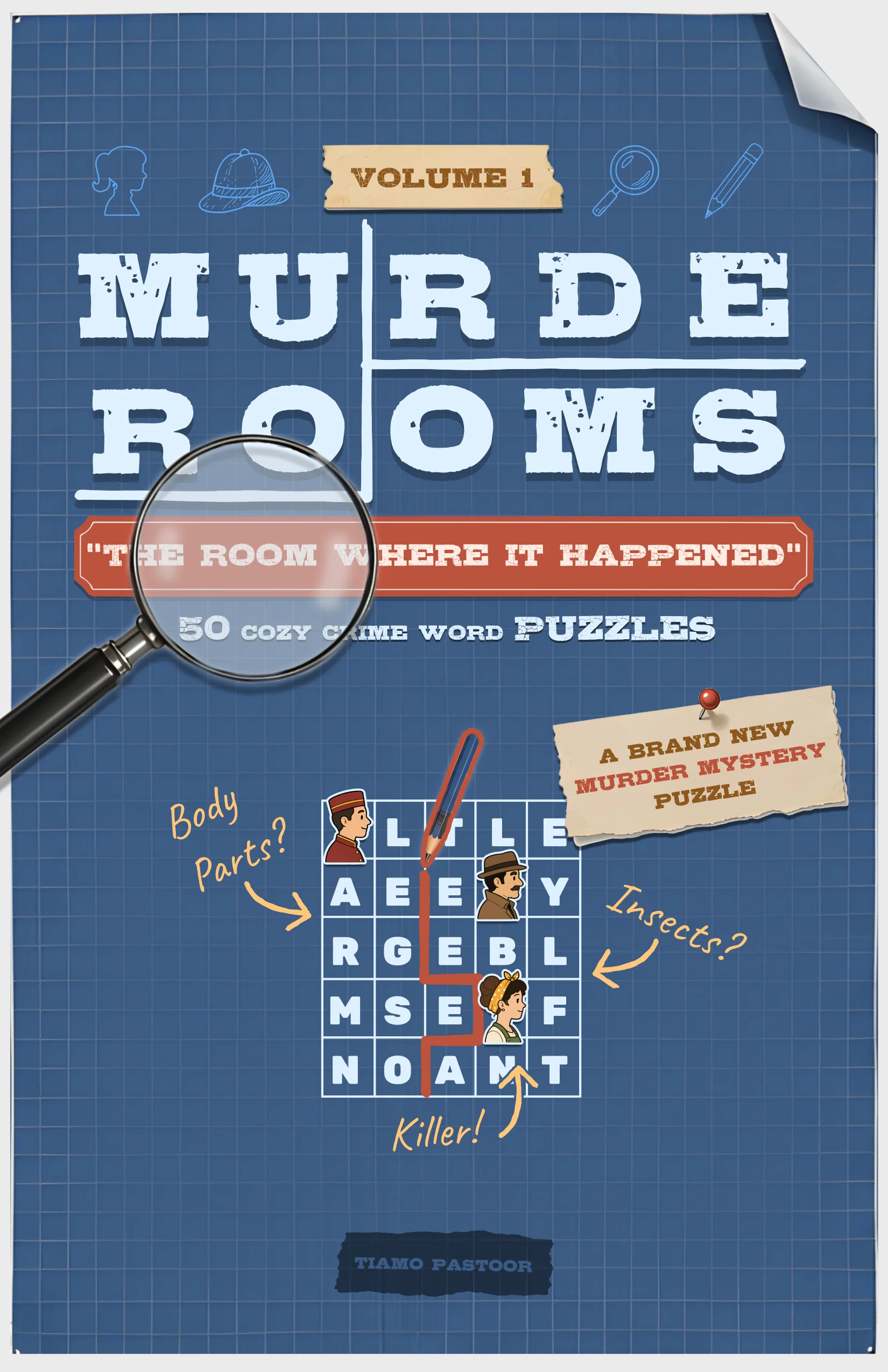
A few months later I had a great idea and invented a new kind of puzzle in the same vein: Murderooms! A twist on Word Search that rewards you for more creativity and finding the killer at the end.
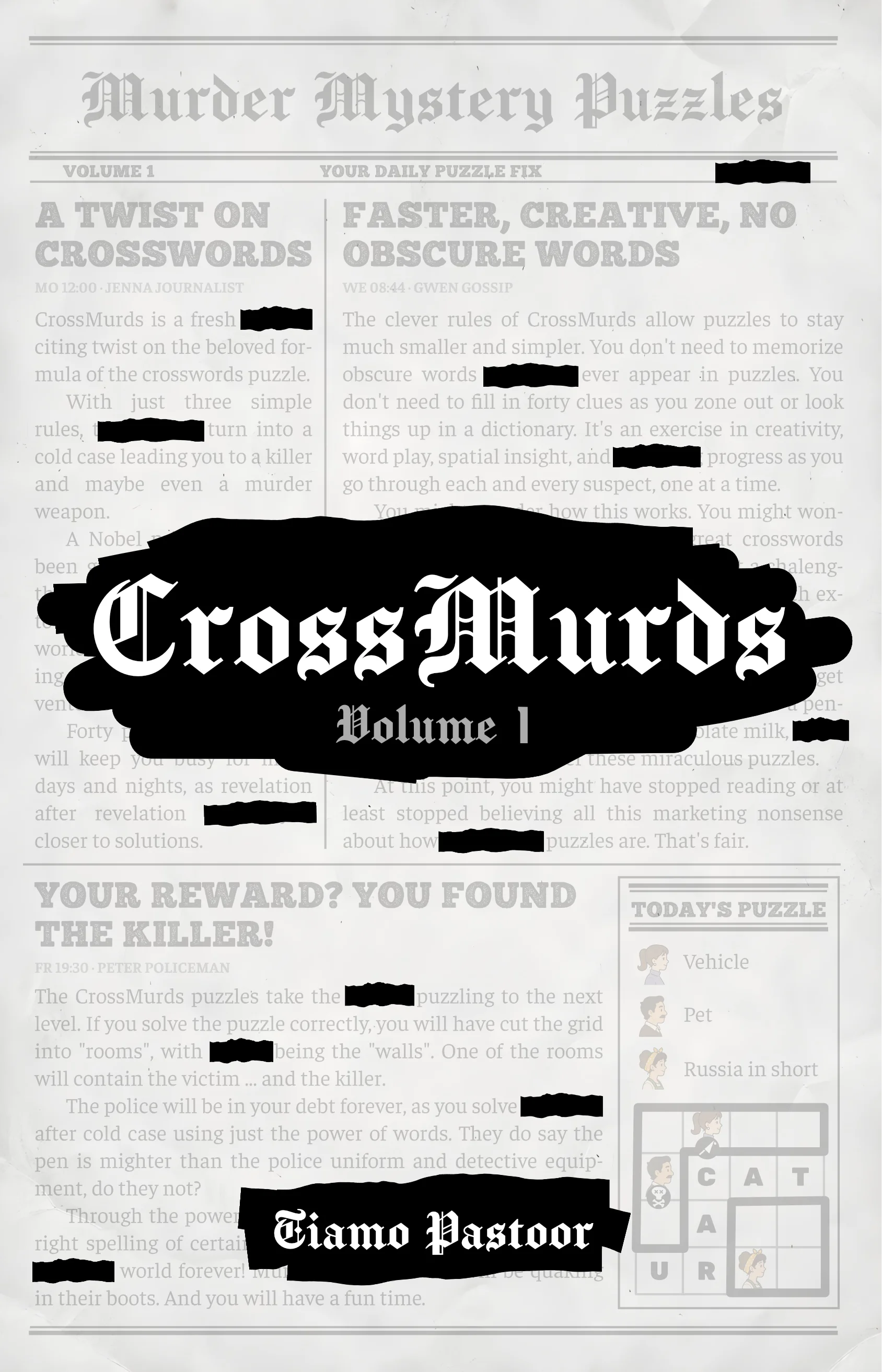
This was such a success that my brain kept inventing new puzzle ideas and eventually came up with another one: CrossMurds. A twist on crossword puzzles that’s simpler, faster, more creative, and doesn’t expect you to memorize all sorts of obscure words and facts. And you find the killer at the end ;)
You can buy it on Amazon (and other places): CrossMurds (Volume 1)!
Or, if you’re one of my Dutch readers, get it from Amazon NL to save shipping costs: CrossMurds (Volume 1)
What is CrossMurds?
It’s a puzzle book you can take anywhere and enjoy for 10 minutes at a time. The puzzles are surrounded by a nice fake newspaper layout, including fake newspaper articles that hopefully make you laugh.
Crossword puzzles (together with sudokus) are probably the most well-known and beloved puzzles. It just made sense to provide a twist on it and evolve the idea further.
I specifically designed it to overcome my own pet peeves with crosswords puzzles.
- Meaningless Words: There are so many nonsensical abbreviations, archaic words, or obscure facts used in crosswords. It feels unfair, it feels like I’m just memorizing this “crosswordese”, it’s not fun.
- Too large: Large grids make it a struggle to connect numbers with clues, find the right spaces, know where to start.
- No goal: You’re not working towards anything. You could fill in completely wrong letters in certain places and still “solve the puzzle” by just filling in something that somewhat makes sense everywhere.
Instead, CrossMurds use …
- Small grids! Just a few suspects giving you a few clues. Most are 5x5 or 6x6.
- Common words! No cheating, no abbreviations nobody ever uses, no words that only 1% of people know.
- Creativity! Especially at later difficulty levels (further into the book), new twists are introduced that provide different creative avenues to discovering the right words. It’s not just a test of “do you happen to know that word”, but more of a step-by-step process of eliminating options and earning letters.
- A thematic goal! By filling in the grid, you’re cutting it into “rooms” (where the letters act as walls). You know you did it right because at the end there’s only one room with two people: Killer and Victim.
When I invented the idea, after some iteration, I immediately knew that it would work really well. I’m quite happy with that. At the same time, making this first volume obviously showed ways to make them even better. Perhaps it’s my perfectionism speaking, but I don’t like that I still needed one lesser-known word on (gasp!) three puzzles, and that some of the bigger puzzles are really hard to solve. (Staring at an 8x8 empty grid can be a bit … overwhelming.)
After designing these 40 puzzles (and 5 “difficulty levels” evolving the idea), I have figured out tools for making the next volume even better.
As always, I hope people enjoy these puzzles, and I hope I can design some more volumes. Maybe some themed ones for Christmas or something.
Until next time,
Tiamo