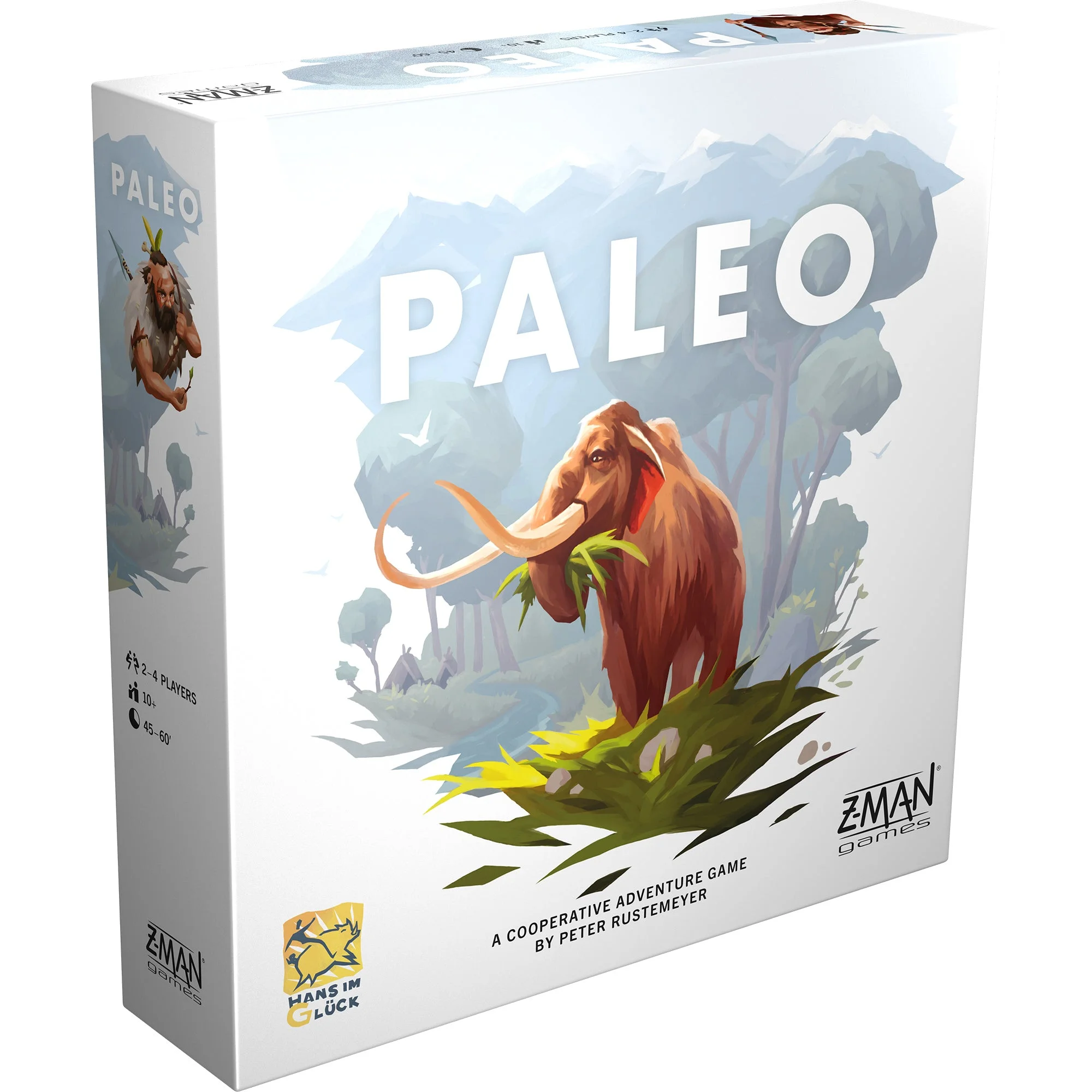
The boardgame Paleo won the Kennerspiel des Jahres in 2021, which is probably the most prestigious prize a board game can win. It also means that the game will be translated to Dutch and sold absolutely everywhere (at a reasonable price), which is why my mother ended up buying it for my birthday that year.
The issue, however, is that she did not tell me ;) We had a group of about 8 impatient people eating cake, while the game only plays up to 4. I still had to read the rules, punch out the material, etcetera. Needless to say, we did not really play the game. We made an attempt, it wasn’t really working, we decided to play it “later this week”.
Well, that turned out to be “in five years time”. We finally had the right group of people together, they were in for a cooperative game, and I had time to check the rules beforehand.
Below I will give my thoughts on the game. As usual, I do so as a game designer, so I’ll also talk about how I would teach the game or simplify it, and any other lessons learned.
How does it work?
You’re a tribe of cavemen in the paleolithic era trying to survive.
During the DAY,
- Everyone gets a shuffled deck of cards. No looking, no re-sorting.
- At the same time, you pick one of the top three cards and reveal it. (Their backs give you a hint as to what might be on the other side.)
- Cards show you several options to choose from. Discuss and decide what to do and in what order.
- They allow you to get resources, invent new tools, or force you to lose stuff to overcome dangers.
- The most important options will give you a piece of a mural (“cave art”): 5 pieces = game won!
- Once everyone has gone to sleep (out of cards or decided to step), it’s night.
During the NIGHT,
- You must pay 1 food for every person in the tribe.
- You must pay for your mission cards (depend on mission you’re playing).
- If you can’t pay for any of these, you take one skull. 5 skulls = game over.
The core of the game is rather simple and quick to explain. My summary above is almost enough to get you started with your first game.
The devil, however, is in the details. A large number of tiny extra rules and symbols and exceptions that you also need to learn before you can play—too large, if you ask me. More on that later.
What did I like?
Cooperative + Simultaneous is like the holy grail of boardgaming!
- It means you’re never waiting on anyone’s turns ( = quick games).
- It means every action involves everyone ( = everyone always pays attention).
- It means people’s usual excuses for not playing a game all wash away.
- “I’m not a competitive person” -> Great, it’s cooperative!
- “I never understand the rules” -> Doesn’t matter, we’re playing together and others do understand them
- “Maybe I have to leave halfway” -> It’s fine, we just continue playing with what’s left of the group
It’s so much more practical and fun to play games this way, that I always try to design my educational board games (for The Wayward Melody) like this.
And indeed, once you’ve played your first round or two, everyone understands the rules and the game plays quickly. No breaks, no people losing concentration, no one person being better or more useful than any other.
Additionally, your choices are quite limited, which is good. If you let people choose any card, for example, they have 10+ options to mull over. Endless delays, endless analysis paralysis. But because you must choose 1 of 3 cards, based only off of a generic back, you can make a decision very quickly. (My personal rule is that every turn in a game should be a decision between 2 or 3 interesting options.)
The art of the game is very good. It’s clear and distinctive, detailed without overdoing it.
This also feeds into the theme. It’s a pretty unique one, but it really makes you feel like you’re in this brutal era trying to make your tribe survive. Things like innovations (leading to better tools) and encounters with animals all make sense.
And make no mistake: this game is brutal. Just one mistake, just one moment of bad luck, and everyone quickly dies and you lose again.
The good part is that you get better over time. Partially because you memorize the cards: you know what’s out there, the range of numbers you need, what can or can’t happen. And partially because, like in every good game, you see the consequences of your actions.
I’ve long held the belief that good games must provide a good learning environment. Fun = learning. The better and faster a game allows you to learn (and get better at it), the more fun it will be. This game does provide a reasonably good learning environment. The high difficulty of beating the game ruins it slightly (by making you scared and unlucky), but it also aids the environment by making every choice really matter.
People online report about a 50/50 win/loss rate on missions. From what I’ve seen, that is only true with dedicated and experienced gamers. Your typical family will lose way more often, so let’s start there …
What did I not like?
Too Hard
I think the game is slightly too brutal. At least, the first few games you play should be easier and friendlier.
It’s common knowledge that your first round of any game is like a “learning round”. If you make it too hard, then players will be scared to actually try things and learn, they will lose so quickly they don’t even have TIME to see all the rules. And they will be demotivated by losing.
It takes a strong mind-set, one that I’ve unfortunately found lacking in many people, to suffer a brutal loss on your first attempt at a board game and still like it and want to try again. Board gamers are generally much better at this than video gamers though. When I design video games, all playtesters unilaterally tell me “a player MUST win their first attempt, no discussion, or they’ll just uninstall the game and leave a bad review”.
I personally don’t see why they did not make it easier. The game is built out of “modules”: you decide which modules to use, which creates a different game each time. The first game uses Modules A + B (as expected). The could have easily made Module A much easier and friendlier. Or even added a unique “Module L (for learning)” that you only use in your first game.
Even though the backs of the cards give you a hint about their contents, the designer kind of cheated by allowing the content to be anything. A forest card gives you food/wood 90% of the time, but sometimes it’s randomly a bad (danger) card that ruins your entire round. You can’t predict this. You can’t know this beforehand, because the backs are identical.
I understand they wanted to simulate how random and brutal it was to live in this period. But this does not lead to interesting gameplay, just scared and confused and annoyed gameplay. The “solution” to randomness is always to plan ahead (“scout”) or have contingencies. Even the cavemen back then would’ve done this. But this game does not give you an opportunity to apply this solution! There is no common tool or system to look at your cards or get more info, and you work on such slim margins that you can’t just store 10+ extra food to “deal with drawbacks”.
I feel like “sudden (dangerous) events” would be much better suited as part of an … event pile. A separate deck of cards that you draw from once in a while, which can be good or bad, you never know. This keeps the randomness and bad luck, but in a more consistent and fair way.
It must be said that, after playing those games and finally winning the first one, I noticed we were missing one card! Maybe that was a really really good card that would have made it easier. I don’t know … because the game does not contain a list of all cards. In fact, NOWHERE on the internet is anything close to a list with all cards in each module. It’s incredibly frustrating.
I understand the designer wanted to keep it mysterious. Make it feel like you’re really exploring things, so they don’t tell you what’s inside each module and you just have to see for yourself. But it feels incredibly stupid to not add a list SOMEWHERE with all cards you’re supposed to have. At that point, it just feels lazy. They didn’t feel like listing all contents to make sure you could play the game correctly and just said “haha mysterious isn’t it?”
It’s not so bad that I would only recommend this game to experienced gamers. But I think, if you’re playing this with a family or with kids, you have to clearly communicate from the start that “living in cavemen times was hard and we’re going to lose the game a lot”. Otherwise it’s a perfect recipe for tantrums and table slams.
I mean, the rules literally state “we recommend not playing your first game with 2 or 4 players, there’s too many options to consider (aka it’s too hard)”. Who designs a game that’s so hard that you can only play it for the first time at one specific player count?
Not Streamlined
My bigger gripe with the game is the setup and finicky rules.
This game has loads of loose bits: tokens, more tokens, places to put stuff, cards, more cards. It’s a lot of work to sort them all out and set them all up. In many games, this issue is softened because after doing the setup once you can be faster and more loosey-goosey. But this game is very strict about those “modules” to include, which means you need to constantly sort cards back into their module and be really precise with this.
Usually, when I set up a game, the players are already seated or at least walking around the table. They always give a gut reaction on the complexity of the setup :p If they see me pulling out all these tokens and cards and filling the table with stuff, they can’t resist stifling a groan or asking me how long the game is going to take.
Paleo has a setup that simply takes too long and sends the message that this will be a super long and complicated game.
You need to grab the right modules. You need to pull out the “special” cards of a module (mission and invention), because they go somewhere else. Then you need to combine it with the deck of “base cards”. But wait, if your module has an invention at the start, it needs to go in the invention stand with the right tokens already before it. But wait, don’t forget to start the game with 5 food. But no, that discard area is for permanently discarded cards, and this discard area is only for temporary ones. Yes, yes, you can put those two things on top of each other, otherwise we don’t have enough space for all this.
Admittedly, it’s better to move complexity to setup as opposed to rules. If at all possible, let players do something once at the start instead of having to do/remember it while playing, all the time. Similarly, if at all possible, put icons and reminders on the material players are holding, instead of asking them to remember rules explained beforehand.
I thought this game was doing that with the complicated setup. I “accepted” it because I knew why game designers do it.
… but this game doesn’t actually move complexity out of the rules itself :(
When I explained the game, I only explained the core. I deliberately left out like 50% of the actual rules explanation based on experience. And indeed, when I was done explaining my summary, I saw players already getting impatient and looking like the information was getting too much. I explained the other rules as they happened (for the first time). This works fine, but some players hate not getting all the rules beforehand, and I myself am exhausted from constantly being on guard and managing that “first game”.
For example, many actions require discarding cards. You “pay” 2 cards (off the top of your deck) to get 2 Food, for example, at no other cost. Except if it’s a red card: then you take 1 damage when discarding. But wait, discarding is not the same as “moving to the graveyard”. In that case, the card is permanently removed, and it does not cost damage to put a red card there.
This simple exception is something I had to explain while playing, several times, and still one of the players kept forgetting while another kept getting it wrong right until the very end. To be clear: I don’t blame them! It’s this little exception that feels like an afterthought because nothing else about the game or the material reminds you of it.
How I Would Teach It
The complicated setup, rules with a bit too many exceptions, and difficulty lead me to recommend that you teach/play the game in a simplified form. As always, this is for new groups and first games. Once familiar, sure, move towards the full rules and more complexity.
Helping
“Helping” is a massive part of this game. Most cards show a “help” option (a handshake icon), which means you (virtually) add everything you have to another player to help complete an action.
But … the rules have to add a stupid exception again: you can help with your people and your tools, but not your deck of cards. So, if someone has to discard X cards, you can’t help by discarding a few from your deck. It’s the only thing that is NOT allowed when helping, and it’s such a weird exception that we completely forgot on our playthrough.
And … that was fine! It was even better. Lots more cooperation and smart moves by letting others discard cards and managing our decks so we went to sleep at roughly the same time.
Later on, I noticed this is actually recommended in the “easier variant” at the back of the rulebook. So,
Rule Change: When helping another player, you can help in ANY WAY with EVERYTHING YOU HAVE. Your people, your deck, tools, whatever.
Damage
Honestly, just ignore it in your first game.
Don’t explain the heart icons on players (say they’re for an expansion if needed) + that dying means taking a skull. Discarding a red card does not make you suffer one damage.
I did not explain damage when I taught the game. And it was absolutely fine. It makes the game easier in the right ways, which is what we’re after here.
Tents & Inventions
The first game has a single invention, the Tent, and a mission card that requires building it every day (or suffer 1 skull). I would recommend just leaving those out too.
The invention deck is still there. You need the tools on it. In this form, it’s easy to setup and explain, and useful to keep in the game.
But in my experience, you’re just not going to do a lot of inventing in your first games, and the inventions you get are just not going to be useful/doable. (There is, again, a lot of randomness here.)
Note that the first game has way fewer cards than later games, and they’re less powerful. You simply have less time and less to work with, which makes inventing stuff not worth it/useless.
So, just leave it out :)
Dreams, on the other hand, might feel useless or superfluous at the start, but I would actually keep them. They add extra cards to the decks, giving you more time. The cards are also always good, battling that randomness and unlucky moments.
General Purpose
I’ve found that lacking a general purpose or simple objective is one of the biggest stumbling blocks for players.
It’s dangerously easy to explain a game mechanically (“so we do this during the day, this at night, and we win with X”) … and leave players with no clue where to start or why they’re doing any of it. Because this game has so many little components and rules and exceptions, I fell into this trap again.
Instead, I would always recommend stating the overall “flow” of what we’re doing in game.
“During the day, we explore to get resources. We need food to feed people. We need these icons on people and tools to beat big challenges like mammoths—and believe me, we won’t survive by backing out of every challenge. We need wood and stone for inventions. All on our own, we’re quite weak—notice how few symbols you have. That’s why most rounds are about helping each other achieve some big thing. When the day is done … we must hope to have gathered enough to feed everyone and see the next day.”
Without something like this, players are like “why do I need Wood? why would I go for this Food option instead of this Dream option? What does it all mean? What are we even doing here?” It’s overwhelming, it’s directionless, and it’s also easy to fix.
Don’t Be Too Picky
Lastly, I’d just recommend to be less stressed about the setup.
- You can easily leave out some of the big cardboard pieces if you don’t have the space (or it overwhelms people)—just have a regular discard pile and stockpile of resources literally anywhere on the table.
- Start with whatever number of food you feel makes the game fair.
- Let people choose the tribe members they like the most, if they want.
- It’s fine if there are some wrong cards (or missing cards) in your deck.
In my experience, it’s faster to make the setup fast, and to make the game look streamlined and exciting before you start … than to do 100% of what the rulebook says. I know, dangerous stuff. Some game designers will be searching for their pitchforks now. But I have 15+ years experience playing games with all sorts of different people in all sorts of circumstances, and have to say that practicality trumps rule adherence.
Conclusion
Pfew, this became way too long again. Please remember that I am a game designer, trying to learn/critique and trying to help others have more fun teaching and playing the game. My criticism is much longer than my praise, but that doesn’t mean I think it’s a bad game.
It’s a pretty good game! It won the Kennerspiel for a reason. The cooperative and simultaneous aspect makes the game very fast and everyone is always involved. It has a unique theme that it simulates quite well. The rules and setup are more than I’d like, but it’s still relatively simple. The biggest evidence of its quality is probably that my group of players wanted to play again after brutally dying in the first attempt.
Anyway, those were my thoughts about Paleo,
Tiamo / Pandaqi