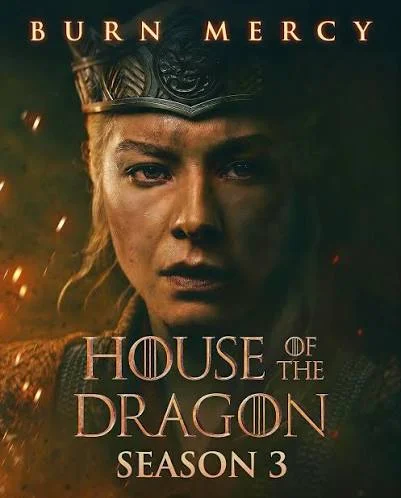
Time flies. It’s been 4 years since I watched the first season of House of the Dragon and wrote a review on it. I still wrote everything in Dutch instead of English back then, so there’s no use telling you to check it out. I’ll summarize it: it was a very favorable review that made me read the actual book and eagerly anticipate later seasons.
Then Season 2 came around, and it was so incredibly mediocre and meh that I didn’t even bother writing a review. I kind of just watched it, shrugged, forgot about it.
Now Season 3 has wrapped up and … I’m afraid I still feel the same way. It’s been received more positively. And indeed, I think it’s an improvement over Season 2, but that doesn’t mean much. The same major flaws keep rearing their ugly heads over and over, minute after minute, episode after episode, and I’m just baffled how it got to this.
In this article I want to explain my criticisms of the show. Unfortunately, in recent years, it seems everyone who criticizes a show is told to “shut up and stop watching if they don’t like it” (or something similar). So I’ll need to do a quick disclaimer. No, I don’t “hate” the show, I’m not “hate watching”, and I don’t think it should be 100% faithful to the book. I am a writer who is incredibly interested in storytelling and adaptations. I hope to be entertained, of course, but I also watch to learn and to find some interesting stuff to talk about.
I was very bored by most of House of the Dragon Season 3, but I still watched it entirely with my full attention to be able to formulate useful criticisms.
Now let’s get started.
Flaw #1: Focus on “Main Characters”
Right from the start, the show decided to make it about several main characters instead. Maybe it was a writer’s decision, maybe it was the higher ups, but someone decided the show needed two or three people that people would “follow” and hopefully “identify with”.
It’s not an unreasonable approach, actually! I’ve read far too many stories from beginning authors that completely forget to have main characters at all. They’ll introduce ten characters in the first chapter and none of them actually turn out to be important. Pretty much all classic popular stories do an awesome job at establishing a main character (or “hero”) right from the very first line/scene. Without it, you’re directionless.
For many types of stories, I would consider this a smart choice.
The Dance of the Dragons, like Game of Thrones, however, is a story about society. About kingdoms, power, legacies, the commonfolk. About large groups of people on opposing sides interacting in interesting ways. The story is specifically not about heroes. Not about singular characters who save the world, or change the fate of the entire world, or who have some big character arc that solves all the problems.
This specific story is the one case where I would absolutely never make it about two main characters (Rhaenyra + Alicent) from start to finish. It needs an ensemble cast. It needs to constantly check the pulse of society, of the larger group of people and their reactions and interactions. (It needs the exact thing that Game of Thrones did right for many seasons.)
Without it, you run into several problems by default.
- The story tries to explore big themes like power or leadership or the horrors of war … but those are wholly societal constructs! You can’t properly explore or show it when focusing on just a few hero characters.
- You need to give these main characters something to do to keep them relevant. But the story doesn’t warrant it. In the book version, Rhaenyra + Alicent fade away after the events of Season 1. In the show, it keeps coming up with ludicrous and convoluted reasons as to why they still get screen time. (And then … in Season 3 … it largely stops being able to find reasons and the main characters get sidelined anyway.)
- Now that you’ve made it about heroes, you’ve made it about choosing sides and portraying them as good. The show leaves out the most pivotal or interesting bits from the books because they would have turned our main characters into more evil or morally gray characters. In its place, it introduces pretty boring or strange scenes that feel like a ham-fisted way to tell the audience “SEE RHAENYRA IS A GOOD PERSON, WILL YOU ROOT FOR HER NOW?”
These are not “plot holes” or “writing errors” or “missed chances”. This is like a poison at the core of the story that will ruin everything from start to finish, no matter how hard you work to polish the story and tighten up dialogue. By making this decision, you’ve set the story against its very own nature, and that causes a slew of issues.
That’s why I wanted to list this mistake first. It basically creates all other minor issues and criticisms. And that’s why the choice to do so baffles me. I can only reason that the writers did not understand why Game of Thrones was popular at all and what story they were adapting at all. This is not a matter of different interpretation or adding your own spin, this is a complete misunderstanding of what you’re trying to do as a whole!
How could this have been avoided?
Season 1 had a very unique structure (first half, big time jump, second half). Why not extend this to the entire show? Why not have every season introduce characters, develop them, then kill them/remove them/make them fade away by the end? It would be like “Doctor Who”, where the doctor regenerates each time, which is a neat way to allow them to keep casting new actors.
You keep a small and recognizable cast of characters. You keep some “main characters” for people to follow for an entire season. But you sidestep all the other issues and can actually include all major relevant players in this story.
The “main characters” of this story are Team Black and Team Green. The “main characters” are factions or societies or at the least groups of characters. It doesn’t matter if one character stops being relevant after a season if viewers are following their entire house, because next season will have some other people from that same house picking up the pieces.
That is, I will say it one more time, the core and the heart of this entire story. How innocent children inherited their parents’ senseless war. How each generation just perpetuates issues it doesn’t understand. This story was BUILT for ensemble casts and one-season-only characters, and they purposely decided to do the EXACT OPPOSITE.
Why? Whhyyyyy?
In any case, you probably have some counterarguments by now. Let’s address those.
Flaw #2: Adapting In The Wrong Ways
Yes, most of the time, criticism against this show comes down to “the book had more interesting ideas and characters”. I don’t think anybody is really arguing against that. Books are basically always better than the film, because there’s much more detail, the writer thought about all the parts for much longer, and whatever is missing can be filled up by your imagination. (It also baffles me how nobody seems to be writing a script before starting to shoot these days, but that’s a matter for another article.)
But, well, films have less time and are much more expensive to make. They require sets and actors and have all these other restrictions, so you need to “adapt” the story into something smaller and more streamlined. We get it. I hope everyone gets that.
My proposals at Flaw #1 would grow the cast by a bit. It would grow the number of unique locations, the big events portrayed, the time jumps per season by a little bit.
Why do I say “a little bit”?
Weirdly enough, House of the Dragon sometimes still tries to include these extra locations and details and characters … but then never really uses them. Just a quick scene, just a mention, just wasting time before returning to their main plot. We don’t actually need that many more details to have a much richer cast that’s able to tell a more interesting story. Things just need to be used better. In more ways, with more variety, with more depth.
At the same time, the show is clearly cutting characters and combining characters left and right. And this is fine! This is how you do it! Some person has 3 kids? Make it 2 or even 1, and find a clever way to merge whatever happens to them. Suddenly the Hightowers become very relevant? Forget about Ormund’s kids and family back home, put their details onto a character we already have, done!
If these kinds of techniques were applied more often, with more care and skill, you could absolutely cut down this sprawling story into something smaller. And more within the budget.
You just have to be smarter about it.
There is a pretty infamous (angry) message from GRR Martin (the writer of the books) about this. It talks about how the showrunners are leaving out important details in their adaptation that would have a “butterfly effect” on the reast of the narrative. About how the show just doesn’t want to deal with lots of kids on set, so they whisk them all away, but this makes lots of later events very awkward or forced. The best stories are an interesting chain of cause-and-effect, and you can’t get a satisfying “effect” if you remove that cause.
So, what should you do when adapting (if you ask me)? Establish the major “cause and effect” events and make sure you don’t ruin those. Everything else, the details and window dressing around that, is fair game. Changes, removal, additions, personal flair, whatever. But you can’t just be like “Why don’t you like this battle? It’s in the books! You want us to be faithful to the books right!?” when you’ve removed all crucial setup and buildup that actually made the battle worthwhile.
Again, adaptation is fine, necessary even, but this show does it in the most silly of ways.
If you don’t want a bunch of kids on set, then just make them so young they can be dolls. Or make them older. Or just mention them a bunch of times without showing them. Or change the story so there’s an obvious reason as to why they’re not there. It’s simple to adapt to fit within a budget—and doesn’t require breaking the crucial parts of the story.
If you can’t show all the major battles, then just merge a few of them (if possible). Or just show the beginning/ending, like Game of Thrones also did quite often. Or just have people discuss them (beforehand or afterwards)—this is a scene we’re sorely missing anyway and that should have absolutely been included for every major battle.
If you can’t include all the characters, then just merge a few. Find a (narrative) reason to lock them to seasons: this character ONLY appears in Season 2 and never anywhere else, this one ONLY in Season 3. This keeps the cast small and contained; actors know exactly how many episodes they get and then you can stop paying them.
If you can’t show all these different locations and places, then just be smart about hinting at them. Film some random forests and orchards, but place some flags and recognizable symbols strategically, so people still know “Oh this is that place or owned by that house”. You don’t need to build a big expensive set. You don’t need to spend 20 million recreating a place faithfully … and when you realize you can’t pay that, decide to just not include the place at all.
For example, the show has several shots of massive armies (such as the Lannister army traveling, the Hightowers army of course, etc). Those shots must have been expensive to make. At the same time, they do not look interesting and do not tell us anything new. Oh? A big army? Some high number of soldiers? Like they’ve told us three times already? Which won’t actually go into action for 7 episodes? Gee, now that I see them vaguely walking through some barren land, I finally understand!
For example, the Battle of Tumbleton competely reverses what’s in the book. An odd change, but fine, it doesn’t touch the overall chain of cause-and-effect too much. (As if The Hobbits would own Mount Doom and Sauron was the one bringing the ring there :p) But then, characters that should not be there are there, and characters that should die don’t die, and so forth. This makes the battle way more expensive to shoot, and makes everything that comes after more expensive and complicated, so now you’ve “adapted” the story to be less practical!
There are obvious and common ways to adapt a story so that it’s good (and/or faithful) but also practical/feasible to make. This show is doing almost none of them.
Instead, all the extra time it saves by cutting major events and all … it fills up with pointless repetitive scenes set in the same rooms. It tries to “add” its own details and extra bits to fill the runtime. Some of that was good, some if it was fine, some of it was just outright bad. Most of all, barely any of it was necessary or progressed the story. Perhaps that’s what makes it extra baffling. Why cut out so many things for supposed time and budget reasons, but then add lots of other pointless things that must have still cost a lot of time and money?
If your source material is more a kind of summary—more bullet points than anything—then why are you not even following the darn bullet points? As many online have stated, the writers had complete license to fill in the details and the missing pieces however they wished. Fire and Blood is written like a kind of history summary book, not a novel. and only a small part of it is about the Dance of the Dragons. GRR Martin just gave them a very interesting blueprint of big events to hit, and the rest was up to them. And they still decided to just not bother with most of these crucial developments?
Why? Whhyyyyy?
All of this combines into a story that “adapts” the original to be … less interesting and way more slow. So let’s talk about that now.
Flaw #3: Slow, Slow, Slow
One of the major strengths of Season 1 was the efficiency and speed. Scenes were short and tight. Important events happened every episode. Things were always progressing at a strong pace. It showed some of it, then left the rest for you to infer yourself. Although my review back then said this wasn’t perfect—sometimes it gave too little information and went too fast—it was pretty darn good overall.
This allowed them to have an incredibly interesting and well-paced show from start to finish. This is one of the main reasons people loved that season.
While they were filming Season 2, their episode count was even reduced to 8 episodes. (And only 4 seasons too.)
So why oh why did they decide to take things waaaay mooore sloooowly since that moment? They had a strong and effective pace that people loved, then they realized they got fewer episodes than they wanted, and they started padding the story with slow-moving nonsense? I’m just … I’m interested in the why behind all these decisions. I think that would be very instructive to know.
I can give examples for days, but I’ll try to keep it short.
- Rhaenyra + Alicent. They spent an entire season having the same argument in the same room. It never went anywhere, it never progressed, it was just re-stating that the issue is still the issue.
- Rhaenyra + Daemon. They spent an entire season having the same argument in the same room. It never went anywhere, it never progressed, it was just re-stating that Daemon is more active and has ruthless ambition, while Rhaenyra stays indecisive.
- Rhaenyra + Mysaria. They spent an entire season having the same argument—you get it.
- Daemon at Harrenhal + Aemond at Harrenhal. They spent an entire season just living their best(?) life at a gray solemn boring castle while a mysterious uncharismatic witch helps out for no interesting reason. They have progressed by the end (“grown” as a character), but that progression still feels sudden and unearned because it only arrives all the way at the end.
Granted, Season 1’s pace was often quicker than average. But Season 1 treated this story more as a societal story, which is what allowed it to have big events happen regularly. Because if you broaden your scope to a larger cast of characters, then there are constantly things happening and possibly big interactions. If you’re not following one main character (“hero”) in real time, then you’re allowed to make time jumps and have other characters do big stuff, and viewers don’t mind.
But even in a more “regular” story, the pacing of Season 2+3 would still be incredibly bafflingly slow. It would still be full of scenes that do not progress anything, or progress too slowly. And suddenly you’re at the end of Season 3 … and you feel like not much has happened at all. You kind of want your time and attention back.
It’s not rocket science.
Have Rhaenyra and Alicent have their argument once. By the end of it, something has changed. It escalated, or a solution is proposed, or their attitudes are clearly different than at the start, something. You can keep your dialogue scenes in bedrooms, if you really want, but now they would actually be interesting and lead somewhere. Because the next time they speak, they can’t have the exact same argument anymore! It has already evolved and you’re forced to come up with new interesting material.
Have Aemond go to Harrenhal and suggest he will experience the same thing as Daemon. Then don’t waste any more time on it! By the end of the Season, we can experience Aemond as a changed man. He could have literally two scenes—one in Episode 1, one in Episode 8—and it would be easy to follow and show obvious progression.
For example, Season 2 should have already had Rhaenyra at King’s Landing, the smallfolk fully turned against her by the end. Season 3 and Season 4 could then dedicate time to all the major interesting events that happened afterwards. People online have been saying “surely next episode must be Event X” for two entire seasons, and by now we can only conclude that Season 4 must be inhumanly rushed or cut out 99% of the story.
Instead we finally get Rhaenyra’s slow turn to madness and losing all support at the end of Season 3. And this really only happened quite suddenly, in a single episode, because Aegon was rumored to have returned. It’s made out to be the big character arc of our big hero in the show, when in reality … it’s just one tiny thread in this bigger story.
If they kept the pacing from Season 1, this would be completely fine and not rushed. If they simply made sure every scene had a purpose and developed towards the next big event, this would all fit easily. We’re not talking about a 90 minute movie here. We’re talking about 8+ hours of story per season! That’s more time than a narrated audiobook of a detailed written version of this story!
Instead, they feel like they HAVE to put the “big climax” of the story all the way at the end, and everything before it is just (very) slow buildup. They feel like ALL storylines have to come to a head in that same episode. But no! That’s the whole point of different storylines! Some of them can climax earlier. Some of them can fizzle out in unexpected ways. They can take turns, move like waves or wind, becoming more or less important every episode. (Many TV shows have found great success doing exactly this by making a different character the center of every episode. That one character becomes important and gets their big moments in that episode, not just in the penultimate climactic episode.)
I watch shows with my full attention. Even in the worst of scenes I can be focusing on a clever line of dialogue or watching the filmmaking techniques to get something out of it. But Season 3 had me so bored so many times that I was considering just turning it off or finding myself considering doing other tasks.
Not because there weren’t enough “big battles”, but because nothing (interesting) was happening for the vast majority of it. When, as I’ve hopefully pointed out, mountains of interesting stuff were waiting around the corner and just begging to be used.
I was really really hoping the final episode would have this big Tumbleton battle with massive consequences and payoff and new interesting threads started. But no, it was a pretty standard battle. Only some 15 minutes at the tail end of the episode. Very minor dragon action. And the outcome is a big fat “we’re not sure and we’re not telling you anything!”
I hate to keep bringing up well-established writing techniques and principles. But another one is that a good cliffhanger shows you something interesting to think about, then fades to black. You show what’s behind the scary door, then cut, instead of just showing the mysterious scary door.
The final episode of Season 3 leaves nearly everything undecided. Where’s Daeron? What’s happening with the dragons? What’s the reaction to Rhaenyra killing their pope + her weird queen speech? Rhaena? Baela? Mysaria? Where are Aemond and Aegon, they said they’d be at Tumbleton?
We can’t even speculate about what will happen next, we can’t be excited about a cliffhanger, because there’s literally nothing to go on!
Conclusion
Pfew, this is all quite negative.
I … I want to praise some parts of the show. I guess the acting was okay. I guess some of the sets and locations looked pretty good. And yeah, some changes/adaptations were sensible and useful. When you focus so much on main characters instead of a bigger ensemble, you do have the advantage of having more clear-cut character arcs and character payoffs near the end of a season.
I can’t give many more positive notes than that.
This is a show that cost ~200 million USD to make. It is the third season, from established (Game of Thrones) writers, at one of the biggest media companies, who have a finished story they can follow, and who take two years to make each season.
What they end up delivering is, unfortunately, so pointlessly slow and boring that it baffles me how we ended up here. Of course, this is just my criticism slash analysis. If you love the show, great for you. I can understand that many people don’t look this critically, or through a “writer’s lens”, and would give the show a positive rating. I can understand the sentiment of “just stop watching if you don’t like it”. A shrug, a quick scroll on your phone, when the show is a bit mediocre or boring.
But I personally think it’s atrocious what they came up with in terms of storytelling and think we should keep people (who spend 200 million + 2 years) to a much higher standard than that.
Hopefully this was interesting or instructive to read. These are just my thoughts at the moment,
Tiamo