Not so long ago, I wrote an article about Murdle and Murdoku. About how they became this big hype over the course of a year or two, what we might learn from that, how it might be “smart” to hop in with your own puzzle.
I ended that article saying that I gave it some thought, didn’t find a great idea, and moved on. Interestingly, that article has been visited thousands of times since launch, confirming just how popular these things are right now.
But, well, our brains work in mysterious ways. After moving on and starting my next educational story for The Wayward Melody—a pretty important one too, about numbers and counting—I suddenly woke up with lots of strong ideas for my own “murder mystery puzzle”.
I found several of them promising enough that I had to drop (or rather “pause”) that story and try to make my own puzzle book.
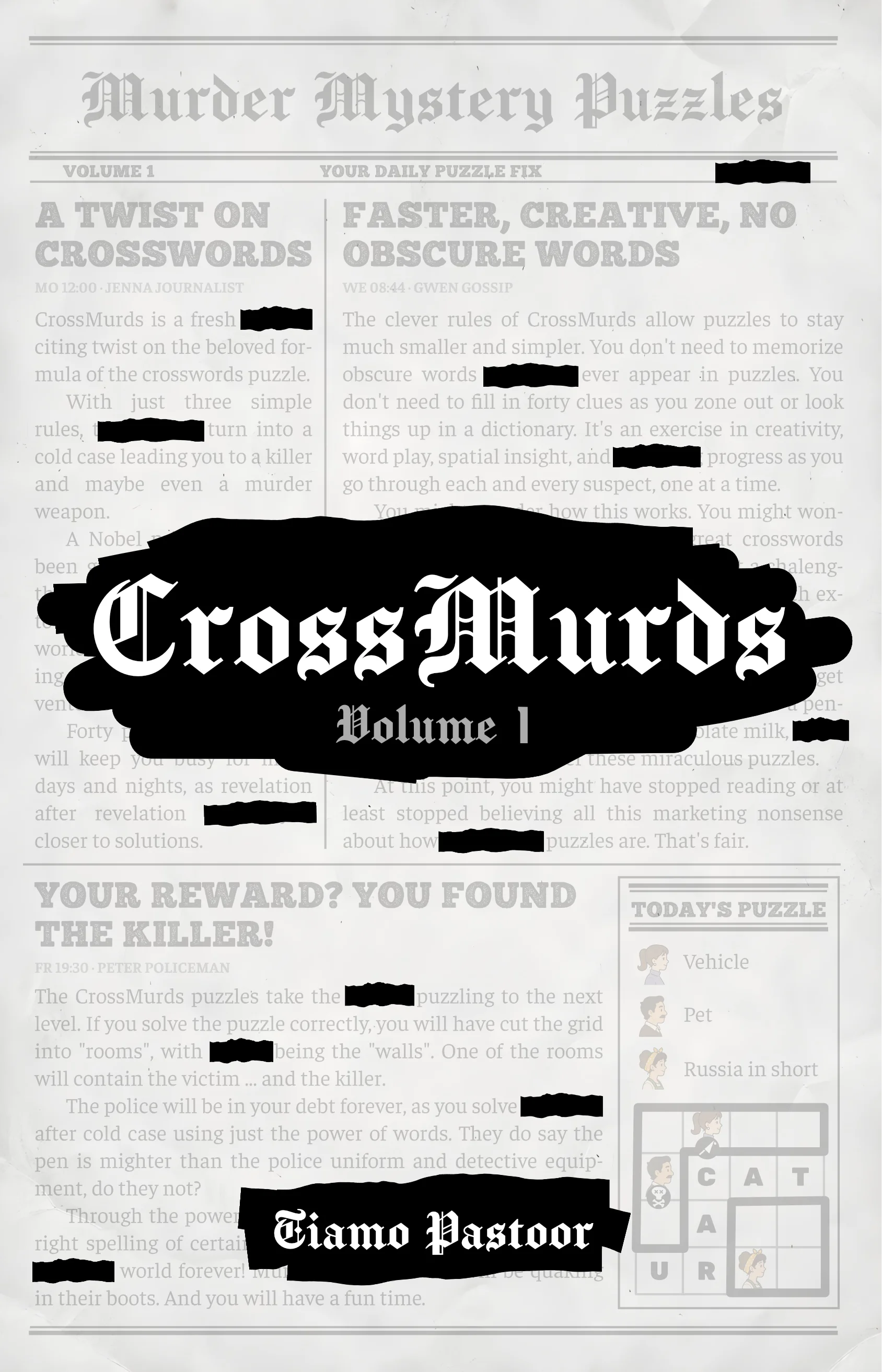
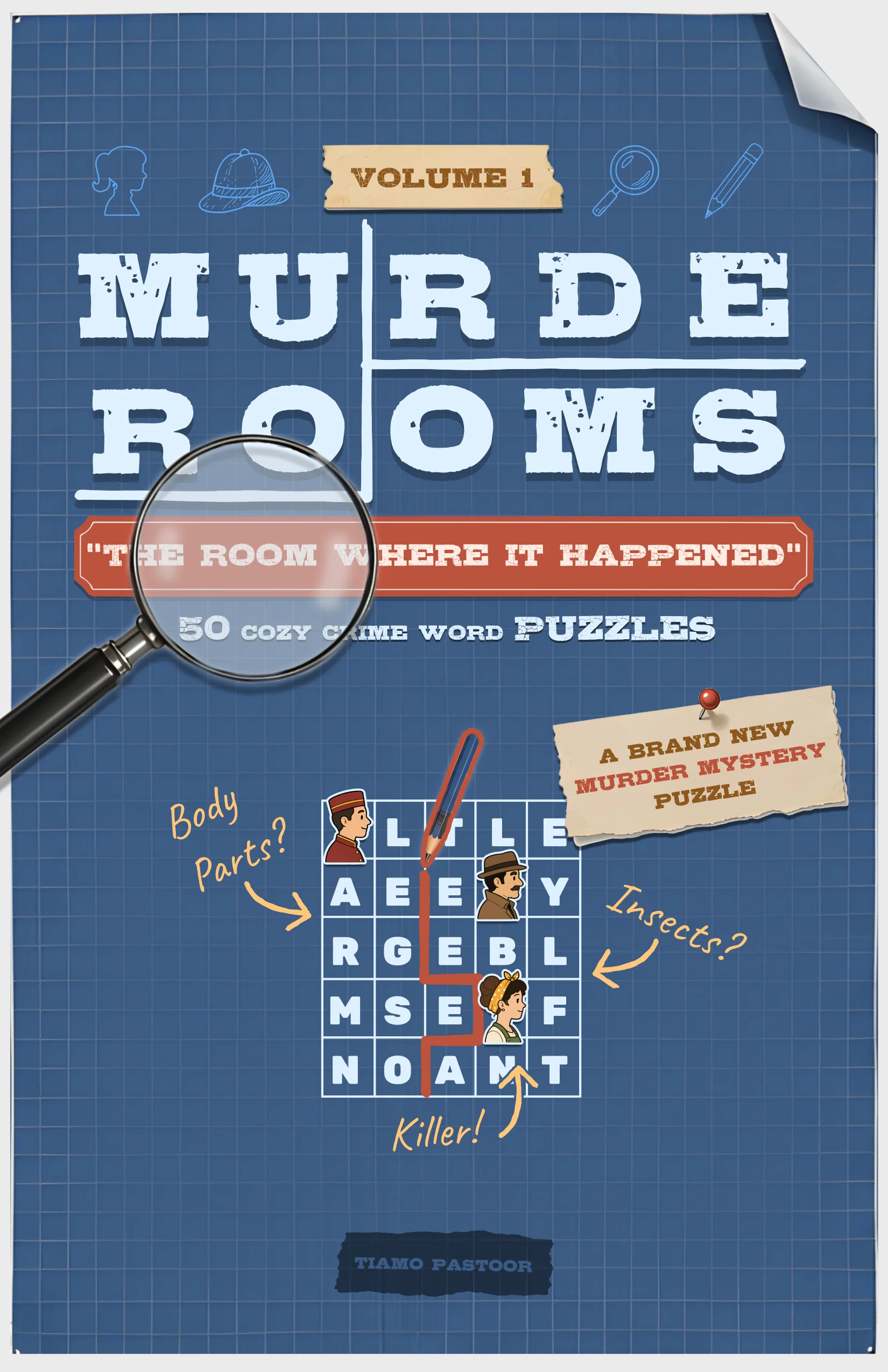
And now … I’ve released Murderooms (Volume 1)!
What is Murderooms?
As I already mentioned in that article, things like “Word Search Murder Mysteries” already exist. Quite a lot of them, actually. The name MurdSearch has obviously been used by now.
But they’re not really a new puzzle. You simply solve a Word Search with crime-related themes, and the letters that are left spell out the killer and murder weapon. It’s fine, it’s clearly popular, but this is not what I mean when I talk about inventing a new puzzle concept. This is just taking something that already exists, something that any computer can generate for you, and pasting a very light crime theme on top.
I was moreso interested in actually new puzzle ideas that have never been seen before.
Then I realized: why have we never added a spatial component to Word Searches? Why have I never seen a Word Search that is about cutting up the grid into rooms or zones? What if we merge Murdoku (“only one room has two people: killer and victim”) and a modified Word Search?
That’s how Murderooms appeared to me.
- You have a tiny letter grid. (It doesn’t need to be big. In fact, bigger quickly makes the puzzle too hard.)
- You’re looking for words that share a theme. (Example: “Ant” and “Cat” are both animals.)
- Draw a line around these words: they are part of the same “Room”.
- There’s only one Room with two people inside (the Murderoom!): killer and victim. (In some spots, the grid contains a person instead of a letter.)
That’s it. Simple to explain, relatively simple to make, but always challenging and different when solving them.
You start with a grid of letters. You end with a sort of blueprint that cuts the letters into meaningful rooms. This is something you can’t just “guess” or “brute force”, you have to solve it. But once solved, the killer is obvious and you know if you did it right: just check the one room that contains two people.
I made a prototype with just a few puzzles and asked others to solve them (with no other explanation by me). They immediately understood the rules and had fun solving them. (In fact, I thought they might be too hard, but my first attempts were actually too easy sometimes.)
This made me believe in the idea and publish it as a professionally designed puzzle book!
So that’s what I did. It’s available in grayscale and color on Amazon and many other bookstores. You can also buy the digital files only (for a reduced price) at my online store, or download the free demo available there.
Puzzle War Stories
I write this article to mention the launch of this book, but also to give some interesting or funny remarks about the process.
Yes, it’s perhaps stupid to drop my current project(s) just to chase a trend. I did so for two reasons.
- I have enough experience making puzzles and self-publishing books that I knew how to make one and that it would not take much time. And indeed, it took ~1 week to make the whole thing (idea, design, puzzles, polishing).
- Over the years I’ve experienced time and time again that almost all commercial success is setting or chasing trends.
I really mean it on that second point! This is my golden nugget of advice to you, and what I wish I had understood earlier!
The way our internet works, the way algorithms push things that are already popular, the way word of mouth marketing works, it all coalesces into a machine that encourages hypes and trends and virality. It’s exceedingly rare to actually earn a livable income if you’re not part of that machine. If 900 out of 1000 people are searching for X, then you’re already limited to at most 100 people searching for your different thing. It has to be amazing to actually sell enough to earn a decent income.
Now, of course, this is mostly reactive. Marketing experts pretend to know about markets and upcoming trends, and they’re wrong or blind-sided 90% of the time. (That’s why they prefer to make trends through advertising, social media, bots, manipulation, bla bla.)
For example, Disney never expected Encanto to be so popular, so they had barely made any toys or products for it and were then kicking themselves for all the lost sales. So incredibly often, something becomes popular among teenagers/young adults, and then two years later that thing is shoehorned into every film and serie and book. But by then it’s both too late and poorly done, because they don’t actually understand why that thing is popular with that age group. And these are decisions made by people who have studied marketing and earn top dollar for it :p
We are arguably past the peak of “cozy crime puzzle” popularity by the time I’ve published a few of my own. But I’ve learned that this is still more valuable than ignoring trends altogether and wishing for a miracle. Because I am absolutely not big and established enough to be setting trends. (Not yet!)
Most of the income I have generated, has been from looking at what’s popular and trying to jump in quickly.
Back to my own work. What did I do in that 1 week?
- I created 50 Murderooms puzzles. (It was 60+ actually. Some went to the free demo, some were scrapped.)
- I designed a lay-out and brand image for these puzzles. (As I obviously hope they find some success and I release more volumes.)
- I sent out updates as quickly as possible to get feedback. This means the idea already evolved before I finished, and I already know even better rules / puzzles I will use for a next volume.
- I fought with my publishing platforms for a day or two ;)
Amazon has an automatic PDF checker. Among other things, it requires that no text at all be outside of their margin. The issue here is that it’s their margin. I have no control over it, I don’t know what the number is, they just want some amount of empty space at the edges of all papers. Probably because lots of beginning self-publishers will create wonky lay-outs with text and stuff that’s cut off. (Been there myself ten years ago.)
The idea is nice, the execution just sucks. In practice it means tweaking and re-uploading this big ass PDF file many times and checking if their system approves or not. Amazon’s book services are sloooow. Sometimes they freeze entirely and you just have to wait and hope it’s done by now. Bleh.
In my case, the issue turned out to be page numbers. They were, as usual, at the bottom of the page, out of the way of the puzzle (to not attract attention). But, well, Amazon decided they were too close to the bottom, so I had to update my Master Page and put all numbers in a weird spot that I personally don’t like.
THEN Amazon rejected my book (for the first time ever, none of my other books were ever delayed) for one silly reason: the text on the spine (the side of the physical book) was too close to the edges. The margins they wanted, however, were … impossible. In fact, I calculated that any book with less than ~250 pages would have a spine that’s smaller than the margin wanted, so erm that must be a mistake right? And if it’s not, why don’t they just tell me “your spine can’t have text below X pages”?
So I tried a second version of the wraparound cover with much smaller text and bigger margins/whitespace on the spine. Rejected again for the same reason. So I submitted a third version that, indeed, has no text on the spine, which is stupid. (I used color + an icon to hopefully still let you recognize the book from the side, but that’s not great.) Every time, Amazon takes 3+ days to “review” an incredibly minor change to a book cover, which in my opinion is not needed at all. I’ve designed loads of book covers; I know the amount of space I added to the text on the spine was enough to never run into legibility/printing/cutoff issues.
But alright, I fixed all that and made sure to remember the lay-out restrictions for future puzzle books.
My other publisher is Draft2Digital (which shall henceforth be known as just D2D :p) They only publish in grayscale, but I knew that going in, so my book still works/looks fine when converted to black and white. But their website has a PDF “preview” that’s just … wrong? It removed some text and images at random, and turned some text into a different (and ugly!) font?
You can also download the actual PDF (which they will send to printers), so that’s what I always do. That PDF looked great, so I already hit publish before I noticed the preview being wrong some time later. I sent an email to their support and got a nice quick reply, albeit a strange one. Because after my puzzle book was already accepted and being distributed, they told me that they don’t distribute puzzle books (because they’re “low-content”)?
I believe this was just a misunderstanding. Puzzle book can mean a number of things. I understand them not wanting to sell a Sudoku book where someone just asked AI to generate 100 plain sudokus and stick ’em in a PDF. That’s also a “puzzle book”.
They mark “low-content” books as things with empty pages (like notebooks or diaries) or repetitive pages (because that just means a tiny bit of the same content over and over). My puzzle books are absolutely neither of those. Each Murderoom puzzle has a different grid, different suspects, different statements, and a little silly custom story to accompany it. It’s more high-content than most other books, I believe, so I hope this will always be fine.
Amazon has a specific section explaining that puzzle books are not low-content and that they absolutely distribute them. As evidenced by all those murder-related puzzle books they sell. I assume the same is true for D2D.
In any case, after lots of battles, vague error messages, PDF tweaking, and reuploading, the book is published everywhere now.
What’s Next?
This always happens. At first, I struggle to find a really good idea or solution to some problem, and then a few days later my brain makes some secret connection and I get too many ideas.
Murderooms stood out as the best and the most flexible, making it easy to get started and just make some. I used the same criteria to sort the ideas and ended up with three more promising ones.
I used my momentum to already get started on one of them (15 puzzles made so far + lay-out design). It depends on the success of those two books whether I’ll put time into creating and developing the others.
The most important part, for me, is that they’re actually new and innovative puzzle concepts. I have no interest in doing what’s been done a thousand times. I have certainly no interest in blatantly copying Murdoku for short-term financial gain, something other “authors” are quick to do. I just want to add new ideas and creative thoughts to the world.
So I picked the handful of puzzle concepts that actually do this. Some of them just need a bit more work to either simplify the rules or really make the “murder mystery” angle work.
Those were my thoughts for today,
Tiamo