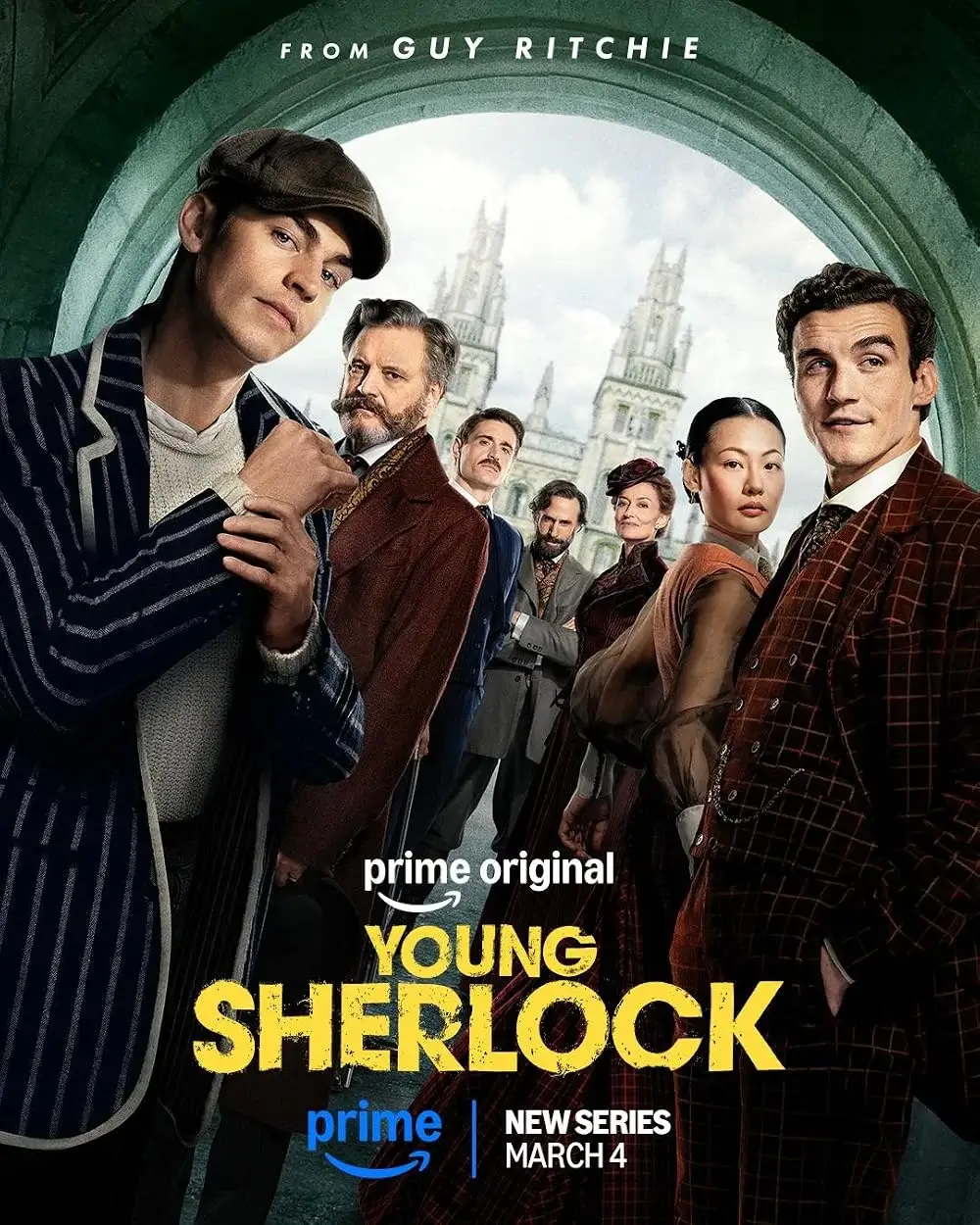
Below are my quick thoughts on the first season of Young Sherlock. I wanted to talk about it because it does a few things right that I’ve been talking about for years in my writing advice articles. Now I can use the series as a recent example of what I mean.
If you’re only interested in a review score, then …
It’s pretty darn good from start to finish! Not amazing or perfect, but also never bad or boring. It strays quite far from the typical Sherlock portrayals, but I like most changes and don’t mind the others. I’d give it an 8 or 9 out of 10.
The series follows a young Sherlock (no shit!), before he’s become this famous detective and is a master at his craft. It allows Sherlock to be more dynamic and outgoing, to create more drama because he makes mistakes, and to provide some new angles into his psyche. For example, a big “twist” that hasn’t been done before, is that Sherlock befriends his arch-nemesis right at the start of the show.
It’s for this reason that I don’t mind many of the things that other reviewers seem to hate. Sherlock isn’t as “smart” as he should be. He is more social and emotional, more loosey-goosey and improvisational, than people think he ought to be. But this is young Sherlock. This is before he starts being a detective and solving cases. I thought it was actually quite fitting that he’d have a less polished personality and detective mind here.
There are still some remaining issues that I’ll mention near the end (as it requires giving spoilers). But for the most part I thought the series was good fun and didn’t find any major issues.
With that out of the way, let me tell you about the two things it does right. It feels incredibly silly that I even need to mention this, but …
- You can see what’s going on. All the scenes in the story are lit and shot well. No looking at a dark screen for 30 minutes trying to figure out what the heck is going on. No looking at the exact same boring plain field or room for half the episodes.
- It’s a varied, well-paced story that does not rely on cheap tricks (like violence or nudity). It’s just a nice story that’s fun to follow. It never goes for cheap jump scares or sex scenes, it doesn’t think it needs to be all serious and melodramatic (to be taken seriously by viewers), it doesn’t linger on slow shots for ages trying to superficially give things more weight.
I’ve spoken several times about what I feel are “classic stories”. The kinds of stories that almost anyone will enjoy, which stand the test of time, which will always be interesting and stay interesting.
Unfortunately, I rarely encounter these stories anymore. Most shows/movies nowadays are literally too dark (or haphazardly shot) for me to even see what’s going on. If you compare the average color of media now versus some decades ago, you can see that shows nowadays are almost entirely gray whereas they used to have a wide palette of different colors.
Similarly, we have an abundance of shows nowadays that are all “gritty” and “serious”. It seems as if, ever since Game of Thrones, shows think they need extreme violence or nudity to attract and keep “adult viewers”. And I’m saying this as someone who thought the first ~4 seasons of GoT were amazing.
You know why they were amazing? Because they told a classic story and you could see/hear what was going on! The final season of Game of Thrones has several huge battles that just look like a black screen on my end. The first seasons of Game of Thrones have great characters, a wide palette of locations, thrilling dialogue, nice build up to nice twists, and even the most intense events are still well-lit.
No! You don’t need any of that! We need more classic stories!
Stories that are interesting because of fun characters, nice twists, and interesting developments. Stories that are confident enough in their action scenes and their tension to actually show them.
And Young Sherlock fits the bill. It provides a nice stream of developments at a nice pace. It has both big action pieces and smaller moments of tension (such as when characters need to hide or mislead someone for long enough). It has the mysteries and chase sequences, but also a psychological, dramatic storyline at the center.It has these serious moments about family drama and death, but contrasts that with a playful vibe that creates scenes that are genuinely hilarious for different reasons.
Variation! Diversity! Contrasting humor with darkness! What an invention!
It has relationships between men and women that hint at something more (romantically), but don’t feel forced to go there. It shows a male friendship (between Sherlock and Moriarty) that feels genuine and earned, without trying to ruin it in some attempt to signpost “they’re not gay!” or something. It pivots from a sort of buddy cop action adventure into a slow-burn family drama, and it all keeps your interest at all times.
A classic story of interesting development after interesting development. Shot in a classic way that allows you to actually follow it.
Why don’t all shows do this!?
That’s all I wanted to say. We need more shows/movies like Young Sherlock. Not because it’s perfect or amazing, but simply because it’s a nice classic story that most people will enjoy, that doesn’t just color grade everything to gray and adds some shocking elements and calls it a day.
Now I’ll give a few SPOILERS. Ye be warned!
Of course, it’s not all sunshine and roses. (Is that the saying? I don’t have internet right now to double-check …)
Sherlock barely does any real deduction. And when he does, it happens so fast, or with so many assumptions, that you (as the viewer) could not have figured it out yourself at all. I wouldn’t mind if detectives/murder mysteries permanently showed certain information on the screen. Just to make sure the viewer knows about it, can remember it/ponder it a few times, before giving the answer. (The BBC Sherlock show actually did this, kind of, with the text messages and thoughts overlaid on screen.)
For example, Sherlock finds a secret passage twice in a way that the viewer just could not have figured out.
- He says “This one looks quite new”, then looks down at a cork on a battle, then pulls it to unlock the mechanism. The viewer has not seen all the corks, nor that particular cork, so this comes out of nowhere.
- Later on, we get a very quick shot of a random floor, then he says “The floor here is worn-out. As if someone walked over it a lot.” Of course, he immediately pulls on the right book and opens the secret passage behind the door.
It’s just a bit meh. The main advantage of detective stories is that they’re interactive. You can puzzle along and figure it out just before the detective. But you really can’t do that at all in this show. And it’s annoying if you can barely follow someone as they make a lot of assumptions, but they turn out to be 100% right every time.
For a show about a very clever group of people that wants you to believe it’s fast and clever … it’s sometimes just very dumb. Sherlock’s father is repeatedly proven to be a liar and a manipulator, and still people keep believing him and his lies. Then, when it comes time to convince Beatrice of this fact, none of them whips out this pile of logical, provable arguments for why she should stop listening to father! No, no, they just murmur some emotional arguments that mean nothing and would not convince anyone.
On a similar note, there are a few twists or reveals that feel unnecessary or too fast. Beatrice fully believes her father and is in his pocket … until a single 30-second talk with mother about some memory never mentioned before completely turns her around? There are some really cool riddles or mysteries in the show, but the script immediately resolves them for you, ruining their impact.
Or perhaps a better example: in the first few episodes, Beatrice is repeatedly mentioned as the dead sister of Sherlock (due to an accident). Then it slowly dawns on them that it might not have been an accident. Then it slowly dawns on them that Beatrice might not even be dead at all. Then they finally have confirmation that she’s alive and find her.
This arc was really nice! Good set up, slow reveals progressing it, nice twists that make sense in hindsight, keeps your interest.
Until … the arc kept going. They find the sister, but it’s not her. Oh, they DO find her, but she’s hostile to them. And so forth. It went on for too long. After the first few major steps, they should’ve just found her and stopped with twists OR there should have been a major twist to end it all (such as her actually being dead after all and their theories being incorrect for an interesting reason). Now it felt like many twists and turns were unnecessary, happening quickly to fill runtime, straying dangerously close to the “cheap tricks” that I don’t want to see any more!
Finally, Guy Ritchie (the director) is known for his fast cuts and quippy style. It showed through here again, especially in the Sherlock/Moriarty dynamic, but actually way less than usually. The style feels more polished, more honed, more applied in the right dose. In fact, maybe it’s applied slightly too little, as I think the dynamic of the show could have used some more fun tricks with editing and dialogue. It’s a bit “plain” now, a bit too safe perhaps.
I think that’s all I have to say on this today.
Tiamo