When I wrote my first reviews, I diligently split them up into sections such as Plot, Character, and Visuals. I would give my verdict—good or bad—about each one and then provide a grade at the end.
Now that I’m older, and have seen more movies, I’ve stepped away from that approach. I believe the best way to look at a film, or a story in general, is by looking at the different layers. Does it work on a superficial level (just a way to waste time)? Does it work on a deeper level? Does it work as an adaptation?
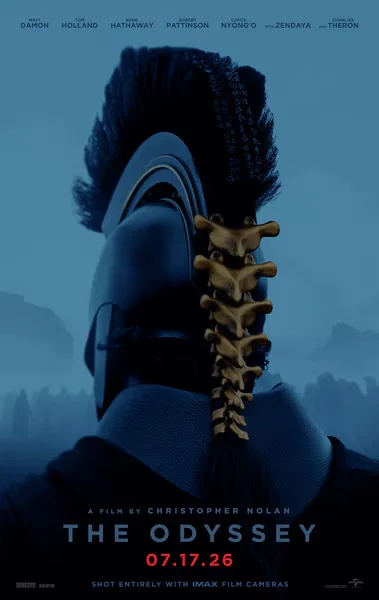
After watching The Odyssey by Christopher Nolan (in the cinema), I was a bit lost for words. I had no clue what my thoughts actually were or how I could formulate them. Until I remembered this approach, and I could finally write this review.
As such, this review is not about giving a fixed grade or some final verdict. It’s about the different layers of the film and whether they work or not. Hopefully it helps some people decide if they want to go watch it. At the very least, it helped me, an author, have some new insights about storytelling and adaptations.
This review is spoiler-free. (Except for some extremely light spoilers about the original text of The Odyssey in general.)
The First Layer: Entertainment
I think everyone agrees that the film excels at being entertainment.
Those three hours fly by. It’s one of those rare movies that feels shorter than it is. One of those 3-hour movies where people actually wanted the film to contain more.
Nolan seems to have discovered some magic pacing formula that he’s been applying to each film. He is able to find the perfect number of storylines and characters, and when to cut from one scene to another, to always keep the movie flowing and interesting. Nothing feels rushed, nothing feels dragged out. A lot of stuff happens in the film, yet it’s not convoluted or hard to follow.
At its core, a story will entertain as long as it stays interesting, and this one does so for three hours. Of course, how you keep a story interesting is the million dollar question every writer tries to answer.
But for a story like The Odyssey, the answers are relatively easy to find.
- You have a very clear conflict and objective. Odysseus wants to go home. Every single scene of Odysseus on the road brings you one step closer, which makes it feel like the story is always moving forward.
- You have no shortage of big action set pieces. After a more relaxed part of the story, you can cut to the next big action scene. Repeat this cycle until the end!
- After doing a big action scene, or having Odysseus take the next step towards home, you can cut to his actual home and what’s going on there. His wife/son trying to keep things under control. Having to decide if they’re going to keep waiting for him to return home—or finally declare a new king. This is a very natural second storyline that directly integrates with the first, as both are heading to the exact same endpoint.
When a story has a clear objective and can always take the next step towards reaching it, you get great pacing and flow for free. Add a wide variety of possible scenes to it, thanks to gods and fantastical elements, and you get a movie that always entertains from start to finish.
The only thing that could ruin it would be if you’re taken out of the story or stop being immersed. Luckily, the audio and the visuals are top-notch. Most movies have scenes that are just too dark to see, or where (even today) you can clearly spot the green screen and the fake stuff, or even where a voice clearly sounds like it was dubbed and edited later. This movie feels completely real from start to finish, grounded and beautiful, probably thanks to a major focus on practical effects and shooting on location. Even Nolan’s recurring issue with dialogue being hard to hear was far less prominent here.
These are pretty superficial metrics, but they’re the only ones relevant for this first layer. You can go to this movie (with zero knowledge of Greek myths), have a great time, and walk out without ever thinking about it again.
Though some knowledge of those myths might come in handy …
The Second Layer: Accuracy / Adaptation
The movie is an adaptation of The Odyssey by Homer. This is a made-up story. Homer might not even have existed. It’s 3000 years old and likely a collection of older tales, shared orally.
But the time and location of the story are real. For years we thought that Troy didn’t exist, until we found its ruins. The descriptions of soldiers and people and weaponry all match the Bronze Age. The events are likely twisted versions of things that really happened, made more fantastical in the retelling.
There is no shortage of people explaining just how influential this story was. I won’t do the same again in this article. I think I can summarize it by simply reminding you that odyssey is a common English word nowadays that means journey or adventure.
So now we get two questions: is the movie an accurate (“good”) adaptation? And does it matter?
No, the movie is not a great adaptation. It leaves out many parts, some of which are baffling to me. The famous “I’m Nobody!” scene is left out, whilst in the original story it’s the catalyst for everything and a major symbolic thread. Kalypso is supposed to be madly in love with Odysseus and holds him captive on her island, but in the film she’s more like a stoic vaguely godly guide helping him. Odysseus is stripped of his most defining characteristics and becomes your typical strong and brooding warrior leader.
Yes, the point of an adaptation is to adapt the story. Update it to what modern audiences would like or even understand. Twist some parts of the story so it more clearly tells the message you want to tell. Focus on only part of a story so you can flesh it out more than the original text did.
I don’t see the issue with an adaptation changing major parts of the story. That’s literally the point. But in this case, it feels like some pieces of the heart and soul of the original text are gone or completely subverted. Pieces that are often seen as the best parts of the story, the defining parts. And, well, how many of those can you change until you’re just telling your own story completely?
At the same time, the movie is not a parody or disrespectful in any way. The scenes it decides to depict are well-crafted and handled really well. Its “spin” on The Odyssey feels very earnest and (mostly) executed well.
So I ask myself: does it matter? I’m one of those people who loved to read Greek myths as a young boy. In fact, I taught myself to read by deciphering these kinds of stories myself. I’m one of those kids that studied Latin/Greek in High School (and only passed because I knew my mythology, not because I had any clue how to read those languages). I was quite familiar with the story going in, but not an expert or anything.
And my main feeling is a mixture of disappointment and understanding. I’m a writer. I have created countless projects including stories in one way or another. I won’t claim to have Nolan’s filmmaking experience, of course not, but I know about killing your darlings, about creative restrictions, about budget and maximum runtime.
Many (not all) of the changes and cuts from the original text are smart and practical changes. If those extra scenes had been included, the film would have been too long. It would have dragged on; it would not be as well-paced as it was now. It would be more convoluted and harder to follow. It would have increased an already massive budget, possibly delayed the film. The movie would have reached a far smaller audience as it would be far less “accessible”. The themes and emotional beats Nolan went for would have been buried by all these extra bits and pieces of story and character.
I’m disappointed we didn’t get to experience some major themes or see some scenes as they should be, but I understand and think it’s probably for the best for the movie as a whole. My experience cutting and editing stories tells me they were reasonable changes for the best. It also tells me that The Iliad/Odyssey likely should be a multiseason TV show at some point instead ;)
I can thus forgive the movie for not being accurate to the original text.
I can not forgive the movie for not being accurate to the time and place when it happened. This is a recurring issue I have with almost all movies the past decades. Relatively speaking, The Odyssey did a great job having diverse locations and different color grading and nice-looking armor.
But taken on its own, it’s yet another victim of the idea that warriors of old all wore the same black and brown boring armor. Of the idea that things only look “serious” if you make it look all gray and dark. Of the idea that those “primitive” people back then would only have ugly and shoddy-looking things, almost defaulting to something that’s more medieval than mediterranean.
Armor was colorful. Houses were colorful. Armor was made of bronze, it’s literally called the Bronze Age. People from different city states had their own designs and flags and ships and whatnot.
I do not believe that a movie with this budget could not create something more unique and colorful than this. I do not believe that this movie could not have constructed or found ships that were actually accurate to the times, instead of picking Viking ships. I do not believe that the weapons and designs they chose simply “looked the best on camera” out of all options they might have tried.
Not because I think you must be accurate to the times at all times. But because the accurate look would have looked far more interesting, distinct, and striking than what they went with. It’s a win-win situation if you go for it!
The Third Layer: Emotion
If I had to describe Nolan and his work, it would be “solid”. He does almost everything himself (writes the scripts, directs the camera, etcetera) and all of it is at least “good enough”. That’s also why none of his movies has ever failed/flopped. At the very least, it’s “okay”. Even the worst critics of The Odyssey (before it came out) ended up giving it a “meh it’s fine” rating once they saw it.
The downside of this is that his dialogue and character work has always been “solid”, but never great. And when that happens, it’s near impossible to get invested in characters or feel any emotion from a film.
Some of the dialogue is just egregious and silly. At some point, Odysseus says “Our age of bronze is collapsing.” This is an idiotic statement similar to someone saying “Boy the middle ages are about to end, aren’t they?” near the end of what we now call the Middle Ages. Everyone knows why it’s there. It’s to hammer home a point to the audience, but it’s done in a way that almost ruins the entire scene.
Many of the characters do not really have a character at all. Odysseus is a playful trickster in the original text. A bold adventurer that isn’t a hero or good man, but someone so interesting you want to follow them. In this movie, he is a pretty neutral warrior king, who seems traumatized or emotionless for the most part.
That’s why I mentioned the “I’m Nobody!” bit earlier. In the original text, Odysseus could have gotten away from the cyclops (Polyphemus) scot-free. But his ego and boasting makes him yell his real name as they’re fleeing, which is how the cyclops can tell the gods who to punish. And then, later in the story, after all the disasters and magical adventures, Odysseus has actually become a Nobody. It’s the catalyst and the symbolic resolution of the story.
But it’s completely left out of this movie. Probably because Odysseus is played more straight, and not as a trickster or a player, which is why that scene would feel completely out of character in this film.
Nolan likes to keep everything “grounded”. Even the many fantastical elements of this story are kept as realistic and believable as possible. We never actually see a god. There is no trail of purple light to signal that anyone did a magic spell ;) And because he’s been doing this for a while, he is quite good at it. The film offers neat explanations for why we don’t see that. It offers a slightly different view of famous events like the Trojan Horse that also make sense.
But it’s not actually “grounded” what he does. Because grounded dialogue would be far more raw, and diverse, and authentic. Grounded characters would have more idiosyncracies to love or hate them. There’s this weird lofty or abstract sauce that Nolan throws over the entire script, which isn’t bad per se, but does remove all the emotion and the rich details of humanity.
The actors did their best with what they had—I thought they were all great. But some of the dialogue and scenes they were given just wasn’t good enough, and it made it impossible to really get invested in any character.
It’s probably a testament to the story that I still felt quite emotional near the end. It’s still a story about coming home, about making things right, about wasted years and senseless wars, and all of that on an epic scale.
That epic part is probably what gets me the most. We rarely get films of this scale, filmed so masterfully. I certainly never see one in the cinema on an IMAX screen. It feels big, and grand, and larger than life. It feels like the story is bigger than just a story. It’s probably why most of the surviving stories of old are “epics”: they make the listener feel as if they are part of some bigger whole, as if real life is a great adventure to be enjoyed as well.
You leave the movie feeling like you have been on a fulfilling journey. Feeling like you want to take on the world or write such a story yourself. While, at the same time, I was absolutely exhausted afterwards. Like I’ve actually been on an odyssey. We watched this movie in the (late) afternoon, and I went to bed early that day because I just could not keep my eyes open anymore, then slept like a baby.
And so, I wouldn’t say the movie failed on this layer. But it wasn’t as effective as it could have been. Making your audience feel things is one of the greatest achievements for a story; it’s hard to make people truly cry or cheer for fake images on a screen after all. You need to bring your A-game to achieve it. This movie just does not have enough authentic, raw, clever dialogue and deep, fleshed-out characters to do so. (Then again, maybe spending time on that would have ruined the epic part!)
The Fourth Layer: Meaning & Theme
What Nolan lacks in the emotional and heartfelt department, he often makes up for in the thoughtful and cerebral department. All his movies have some smart ideas they play with or some clever structure to expose certain themes. It often feels like Nolan just wants to put a spotlight on some issue or message, but he (begrudgingly) has to make this whole action movie around it to get people to watch it ;)
Looking at this layer explains many of the changes he made in the other layers. He made Odysseus less playful and boastful, because he actually wants to use The Odyssey to tell a story of trauma and regret. He focuses more on the aftermath because he wants to suggest the idea that the Trojan Horse trick actually caused the downfall of these civilizations that followed (which is real, proven history). He does not show the gods or typical magic, because he wants to convince you of the idea that gods are ever-present in forces of nature / the way the world works (and that you should not look for gods in people).
It repeatedly mentions “Zeus’ Law”, which means you should be a kind host to any strangers because they might be Zeus in disguise testing your character. (Honestly, it mentions it a little too often! Too “on the nose”, sometimes, because Nolan just isn’t good at natural dialogue.) The story explores the validity of this law and suggest that the Trojan Horse trick was the biggest way one could ever break the law—and that this caused all the bad stuff that happened afterwards. It suggest that Odysseus doesn’t think he deserves to come home because he ruined the home of another civilization.
These deeper meanings and themes are introduced, explored, and resolved quite well. Nolan chose this interpretation of the story and clearly went for that. Some scenes in Hades (The Underworld/Hell) + Athena’s role + Sea People reveal + flashbacks to the Sacking of Troy … they all add up to give the movie some extra weight and some extra ideas to chew on. It somehow manages to have a third act that’s very tense and riveting, while still taking the time to actually have the story and the themes land with their full weight.
I still think, though, that it’s somewhat lacking in this department. The movie simply spends a lot of time on action and fantastical encounters, on slow burn scheming back home, instead of really exploring these themes. It doesn’t feel like Odysseus changed considerably or that his character had grown by the end of the movie. His “goodness” had basically always been there, his war trauma just made him solemn and introspective. All the extra psychological, mythical, symbolical stuff attached to every encounter with a “monster” (in the old text) had to be stripped here for lack of time.
Additionally, this movie does not try to do anything clever or new. It’s not a requirement, of course, but it’s a big plus and somewhat expected in a Nolan movie. A play with time. A recontextualization of what you saw before. Something unique in the way the story is told or constructed or experienced. The Odyssey is a pretty straightforward linear telling of the story that does not try anything more deep or unique, which also means there’s less need for a second viewing or to think about it long after watching it.
In the end, the movie has some deeper themes that give it more “staying power”. My brain kept thinking about some of these ideas/themes for days after watching the movie. At the same time, once that period was over (and now that I write this article), there’s nothing so groundbreaking or deep about this movie that I’m still thinking about it (or want to watch it again/talk about it with people).
Compare this to something like Oppenheimer, The Prestige, Inception. Compare it to a TV show like Andor or Arcane, which had me thinking and researching and philosophizing about the thing for weeks, because the more I looked at this piece of storytelling the more meaning and depth I found.
Maybe Odysseus was changed to be less of an narcissistic bastard because higher-ups thought it would make the film more appealing. Maybe a lot of extra depth and meaning was cut for similar practical or marketing reasons. (Such as … IMAX projectors not being able to go on for longer than 3 hours.) We don’t know. But it feels like the movie has serious missed potential and could have tried at least one twist or unique structure or unique perspective to make this adaptation of The Odyssey worth the (re)telling.
Conclusion
As pure entertainment, the film is amazing. It looks stunning, the action is amazing, the pacing is perfect, you are taken on a satisfying journey that keeps your interest.
As an adaptation, it’s not great. That’s not the end of the world, because you can’t fit the whole story inside a single three hour movie. Many changes are reasonable, many additions help the overall movie. The fact that it’s inaccurate for the time period, which makes it look like all the other sword and sandal movies ever (and less visually striking as it could have been), is a bigger disappointment.
As an emotional journey, it works, but mostly because of its epic scale. It’s a massive, ambitious movie. A masterpiece for the amount of effort and craftsmanship that must have gone into it alone. It lifts you up and it takes a while to land after the movie has finished. Others who saw the movie all told me that it inspired them to go write their own epic stories (or similar endeavors). The dialogue and (female) characters are, unfortunately, of the typical Nolan quality.
As an exploration of deeper themes and philosophical meaning, the film works pretty well. Nolan sacrificed a lot of the other elements—such as more threedimensional characters—to get his themes of trauma, war, home, and civilization into the film. I thought they were handled quite well and had a satisfying payoff in the end, but they were nothing amazing or new.
If you really want a grade, I’ll probably still give the movie a 9/10. That was my initial feeling in the hours after leaving the film theatre. I feel like further analysis, such as writing this article, always brings my mental grade for a film down (and unfairly so!). Simply because you start nitpicking and focusing on tiny details that didn’t actually ruin your viewing experience.
Those were my thoughts.
On a slightly related note, I just want to mention Nolan’s work ethic. This movie was shot in 90 days. Every interview is just about how everyone is working so hard, Nolan most of all, because they all truly believe in the movie and want to make it a masterpiece.
Nolan has these simple rules such as “no chairs on set” and “no phones”. He has no social media and doesn’t engage with any of the bullshit online. He writes and polishes the script before he starts shooting (what an idea!), and look what happens. You get great movies delivered on schedule and on budget! The release date for this movie was announced a year in advance, and some early tickets were even sold back then, which was while they were still filming.
I wish more people would realize the poison that social media and smartphones represent. That it’s idiotic that we start filming million-dollar projects before a proper script is even done—the script makes or breaks a movie, yet it gets the fewest time/attention/funds. That we could achieve so much more if we simply set a reasonable bar of quality that we expect those around us to meet.
I think Nolan should be an inspiration to storytellers and filmmakers (or creatives in general) not because his films often end up being good, but because his process is good.