Once in a while I read some bestseller books that do not interest me. There must be a reason such books are successful, and so, being an author, I try to learn from them. (Also, variety is the spice of life!)
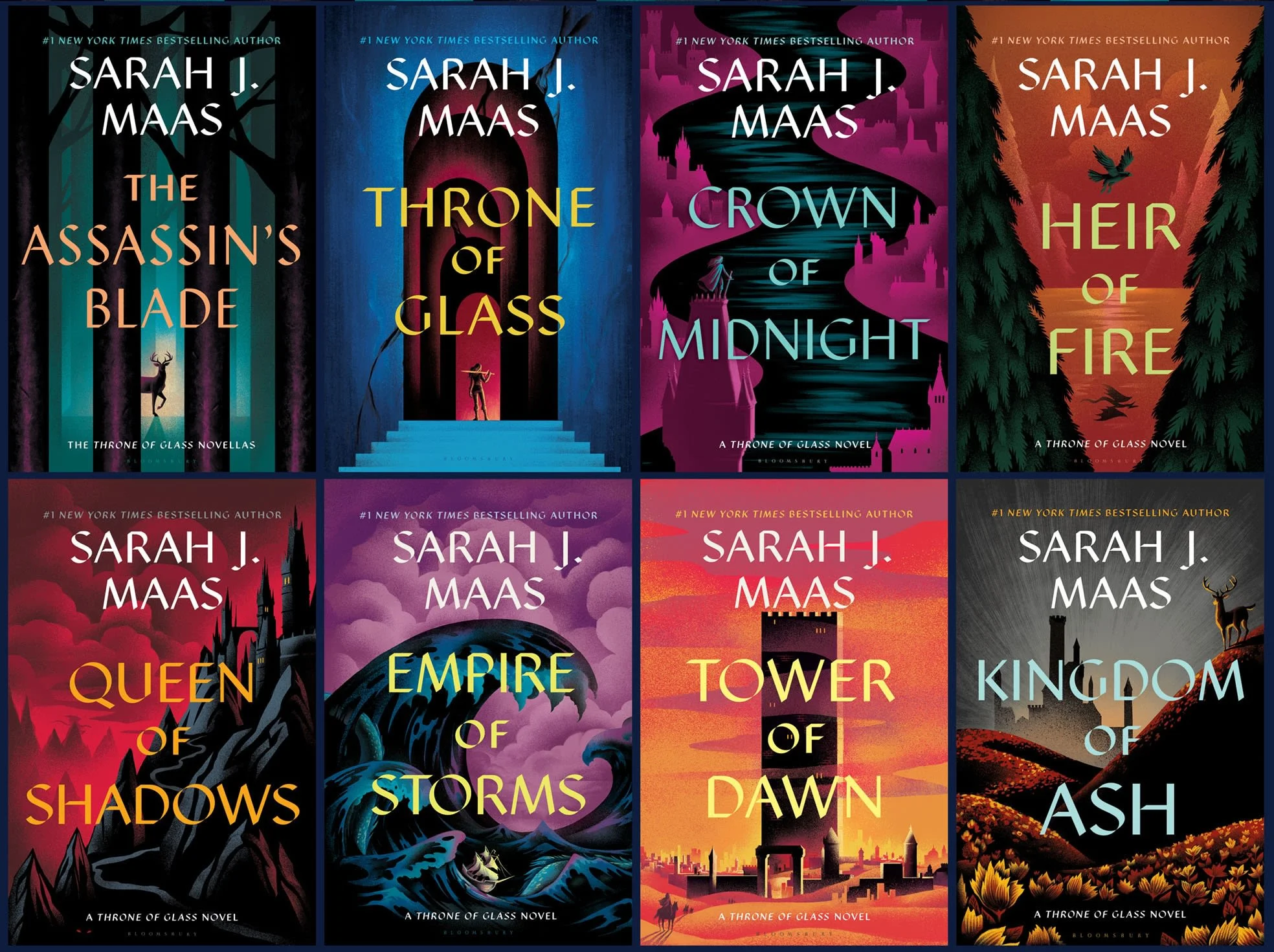
The name Sarah J Maas had been on my list of “read a book by this person someday” for the longest time. Now the moment had finally arrived! I picked one of her series without knowing much about it besides some metadata marking them as fantasy.
And so it was that I started reading Throne of Glass (the first book).
I ended up reading the entire series. The seven main novels, that is, not spin-offs and novellas and other works like The Assassin’s Blade.
(Now, if you’re a fan, you might be about to tell me I SHOULD have read that book. I know. I was so confused by the main story that I looked up if I missed anything. Apparently that book explains a lot. But if a story is so crucial for your series … make it an actual part of the series, not an optional novella!)
The fact I finished it says enough about the quality. The books are at least good enough to keep reading, though I must say that my bar for readable books is very low.
At the same time, the fact I finished it is a bit of a surprise to me. Beyond book one and two—maybe book three as well—I was never really interested or engaged with the story. I was never eager to read again, or reading chapter after chapter because I couldn’t put the book down, or wondering how the story would continue during the day. Finishing the series felt more like a disciplined habit than anything else … but I did finish it at a good pace.
So what do I think? I’ll try to keep this short because I’m pressed for time. But if you’ve read any of my other (book) reviews, you know I rarely if ever keep that promise :p Also, no (real) spoilers.
What The Author Really Wants
This series starts off pretty clearly in the realm of fantasy. It has a strong start, with Celaena being released from prison, to fight in a contest to decide who will be the king’s assassin. This creates an immediate and strong opening, it creates a useful arc for the first book (“the contest”) that always gives clear momentum and goals, and we can slowly discover the magic and the world and her past.
I thought the first book was quite good. If it wasn’t, I would’ve never started the second book. It’s clearly fantasy, but in an accessible way that’s mostly rooted in reality, which is what I (and I think most people) prefer.
Sure, there is some romance, a hint of something even more explicit. There are elements that make it feel more like a cozy story or like a romantic novel, but they’re just little bits of useful spice to make the main course more palatable.
But then!
As the series goes on … it becomes increasingly clear that the author just wants to write relationships and sex scenes. That’s fine, but it’s not really how it started and how that first book is marketed (consciously or not). Basically everyone meets their soulmate and knows they want to marry them in like a few months time. And the big thing they’re building up to is always some amazing amazing first-time sex. At some points, the entire “main” story, the fact it’s a fantasy at all, is almost forgotten or begrudgingly continued after a while.
And again, this is fine … if it’s what the series promised and worked towards from the start. And if it’s done well. Some relationships were handled beautifully, others were not. Some buildup towards an eventual kiss or sex was handled well, other parts were just repetitive or clunky and I ended up skipping more and more near the end.
Was I ever really in doubt about two characters and their relationship? Was it ever tense or exciting? Not really, not for me. You know two people will end up together. You know they will inexplicably love each other until the end of time after knowing each other for a week. The story makes a halfhearted attempt to make you believe otherwise, and unfortunately that’s where a lot of the words go (instead of progressing the main story).
Most of all, I was incredibly confused about the general image of romance that the author portrays. We’re talking about a female author, writing for a female audience, who specifically tries to highlight her strong female characters and their journeys several times.
Yet I find that all the women have personalities but are also somehow sexualized immediately, while all the men have almost no personality and only exist for brooding, grunting, snarling, and being incredibly muscular of course.
At some point it becomes incredibly exhausting when the response of every male character, in every situation, is to “snarl” or “grunt in warning”. Somebody says something that could, with some wild free association, be construed as a criticism of their girlfriend? Time to immediately overreact and play your stereotypical role as the grunting muscular warrior again!
At some point it becomes exhausting to read that every young woman introduced has “considerable assets”. It becomes confusing when every story line’s climax is finally having sex, but at the same time it is often swept under the rug a little bit. Instead of integrating these elements into the plot, really going for it, such events are written off with one-liner euphemisms, like a lazy wink to the reader.
I’ve since discovered that her later series are much more clearly in the romantasy/erotica genre, and marketed as such. And, well, it shows in her first books. It just feels like a bait and switch here, because the first few books are pretty good introductions to a semi-high-fantasy series, and then it devolves mostly into romance and relationships and sex.
Okay, I’m exaggerating a bit here, just to make the point. There isn’t that much sex. And these are thick books, there’s enough space to include such scenes. And yes, the core story is always continued and eventually resolved, but it’s pushed back so far that it’s just not why anyone would be reading anymore.
What Annoyed Me
The series feels like two different series stitched together in many other ways too. Not just the switch in tone and tropes, but also many story decisions that clearly stand out to me as a writer trying to solve problems in a bad way.
It’s frustrating to read something so illogical. It’s mostly disappointing, really, because I liked that first book and thought this balance of fantasy and romance had potential. Several ideas introduced in that first book for this fantasy world are begging for further exploration and tense storylines, but they never come. Instead I have to read about the main character giving a blowjob to someone she just met a few months ago but has now decided is her soulmate.
I’ll give a few mild/vague spoilers now, just so I can give a specific example.
In the first book, one important and interesting character dies halfway through. Celaena blames Chaol. (He is captain of the king’s guard, also the one who picked her up in prison and brought her to the king for the contest.)
Why does she blame Chaol? Because he “didn’t stop it”. He didn’t stop a thing he had absolutely no idea was happening and absolutely no control over. He failed to act on zero information, influence, or requirement to act. Wow! What a disgrace! (All Chaol knew was one line the king told him about this character maybe needing extra security.)
The scene is purposely written to communicate that she would have killed Chaol right then and there in vengeance, if she hadn’t been stopped by someone else.
And I’m like: what the fuck? How are you even angry at him? How are you angry enough to justify killing him immediately?
How is this a main character I’m supposed to be rooting for? How is this a good sensible person that I want to follow at all?
This one moment is repeated in her mind many times afterwards. She keeps confirming how Chaol is to blame and how she hates him now and how she really wanted to kill him. She thinks she is right and she acted right.
It’s also not a “character growth” or “lesson learned” thing, or even something with interesting consequences at least. I can kind of get behind the idea of showing her growth from “assassin with nothing” to “queen leading an army”. But the issue is that this just isn’t what’s on the page, at all.
Throughout the books, Celaena repeatedly …
- Does not explain her actions and intentions at all to her allies.
- Tells them lies or tells them nothing at all, then does whatever the fuck she wants. Endangering people, hurting people, breaking promises, making situations worse, learning nothing and doing it again the next time. And the next time.
- And then miraculously, with even the reader having no clue what just happened, her secret masterplan saves the day.
- (Thus proving that, in the end, she does still solve all her problems with violence and shady tactics and the ways of the assassin. She never really changed at all.)
No. Just no. You can’t make someone act like the absolute worst and untrustworthy leader and human being ever, while portraying them as some hero that everyone she meets wants to follow into a war. You can’t give the reader no information at all, then all of a sudden make several fucking armies show up “because Celaena wrote them a letter asking for help, secretly, without even telling you—they’re friends from long ago, you understand right?”
The first few books were tightly written stories with clear goals and character motivations. Yes, there were some odd/annoying moments (like the scene I mentioned), but they were rare and I figured they might lead somewhere as well. But from the third or fourth books onward, the story shifted to meaningless nonsense about a terrible leader and a liar who saves the day every time with luck and things not explained to the reader. And then she goes off to have sex with her soulmate :p
Just not the books I signed up for, or that I would ever sign up for if I knew what was coming.
Let’s End On A Positive Note
So why did I finish the series anyway?
I already mentioned the “sunk cost fallacy”—after reading a few books, halfway a series, I might as well read the other half. Get my answers, be able to write this review, be able to close off that chapter in my life.
I also mentioned that the series starts off really strong. I thought the first book was pretty good.
Most of all, the series was just “good enough”. The prose was clear and accessible. The characters and their journeys were interesting enough. I wanted some answers to a few things, even though I already knew they’d probably be disappointing and get way less time than these two character’s first kiss.
What I think keeps the series afloat—and which is my biggest lesson learned—is that it has a really strong overall structure. Every book has a clear idea of the overall arc that characters will be on and the steps that will be taken towards the final confrontation. This clear objective makes a story so much easier to write and to read. It gives you momentum and a horizon for free, while also giving you “restrictions” that force simplification of the plot and the characters.
For example, book 5 and 6 see the characters separated in different locations. This new location expands the fantasy world, bringing all sorts of new characters and cultures and parts of the world. But it also clearly sets a new limited objective. These people will be here for the entire book, solving this problem, with the slight promise that they will reunite with the others (in, say, book 7) with what they’ve learned/accomplished.
You can view it as the gamification of story. Characters keep progressing, keep leveling up, keep doing new quests to achieve something they need for the next quest, and so you get this short feedback loop of satisfying progress and clear goals to work towards.
- The first book had the contest.
- The second book was about her past as an assassin and dealing with that.
- The third/fourth book was about figuring out what was up in some other place and winning over their people.
- The fifth/sixth book, as stated, are about being split in different locations to achieve the different goals there.
- And through it all, they need to find three “Wyrdkeys”, so now we have a clear “counter” that ticks up every book, bringing them closer to that goal.
At the very least, the author knows how to structure an overall series. How to give each book its own theme and its own place in an overall smooth arc towards a finish line. How to write just enough progress each time to keep you reading, even if annoyed or disinterested.
Okay, this became way longer than intended. Again. And I can’t really put a star rating or a grade on this series to finish it off. Some parts are really good, some are really bad, most of it just feels like the author wanted to write something more explicit. (While, if you ask me, simultaneously being bad at interesting relationships, sex, male/female personalities, and other relevant aspects. Or maybe I’m just out of the loop and secretly every woman is pining for a muscular man who grunts all day and secretly looks at her “considerable assets”.)
Those were my thoughts,
Tiamo