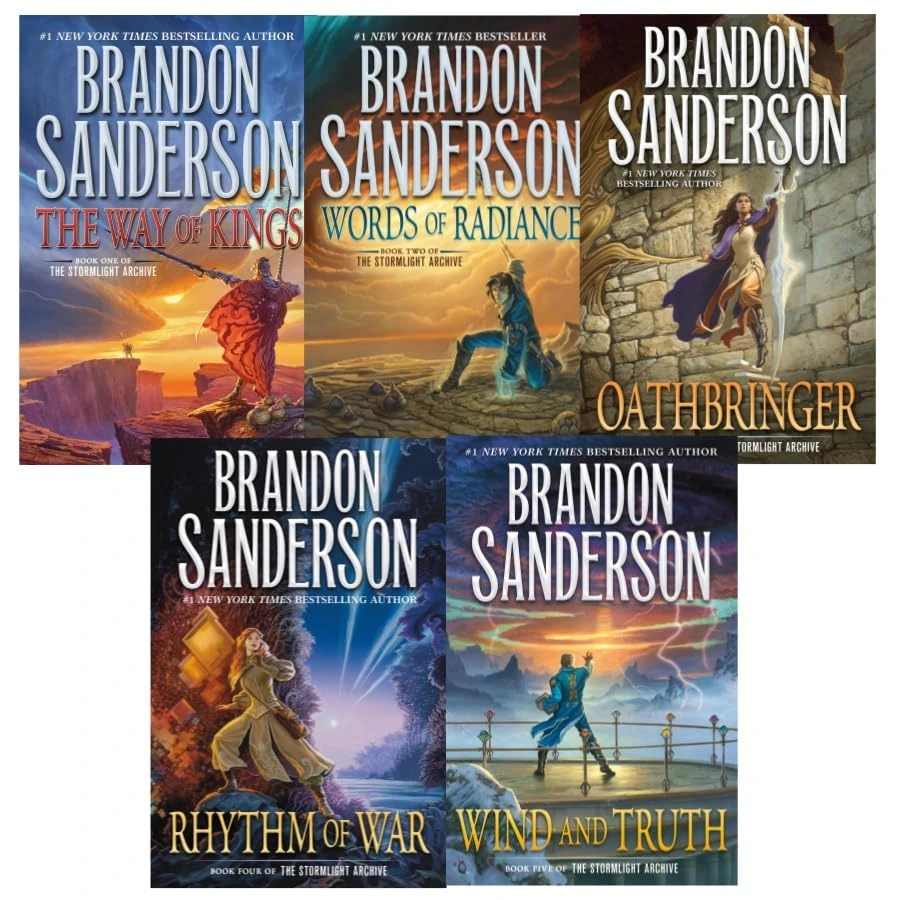
A long, long time ago I started reading The Way of Kings. It’s the first volume of The Stormlight Archive by Brandon Sanderson, of which the first “arc” (books 1 through 5) have recently been completed. I didn’t know this at the time, however, and just started reading because I saw this author’s name absolutely everywhere.
I stopped five minutes later.
I was confused, so very confused, and picked up a different book. It wasn’t even that I disliked the opening pages, though I’ll give some critiques of it later in this article. I simply hadn’t read a book in a long time. Like most people, I loved reading (and writing) when I was young, then our amazing system of education made reading boring and stupid, and it took me until the start of university before I bravely picked up another book.
As Brandon himself has said: the first few chapters of The Way of Kings are … tough. They are meant to be. They show what the rest of the series will be like, and if you don’t like it or can’t follow, then the rest of the story will probably not be for you. For someone who hadn’t read a book in years, it was too much and I put the book away.
This article could have ended right there. Instead, I picked up that first book again some ~3 years ago and … didn’t really see why I struggled with it back then. Years of regular reading really does make a difference! Who would have thought? Suddenly those opening chapters made sense and used simple language. I breezed through that first and second book. Then I decided to take regular breaks—to allow myself to read other books and because I wasn’t that interested—which left a 6–12 month gap before reading the next volume each time.
And now, finally, I’ve read the entirety of the first arc! Books 1 through 5, fully read by me. It honestly feels like an achievement, as if I should be receiving a diploma for it ;) That’s thousands of pages of a pretty complex story. Many stable hours of reading over the course of many years, in which me and my circumstances changed too. Something old me, who was confused and put the first book away, could never have imagined.
So … what was my experience? What do I think? Would I recommend the books to anyone? What did I learn from it (as a writer), and what did I learn about myself (as a reader)?
I wanted to write this article to put down my thoughts.
What’s the idea?
Before we continue, let’s make sure everyone understands the gist of the story. There will be no spoilers until after the spoiler barrier below.
The Stormlight Archive takes place on a world with a peculiar type of magic. An ever-present storm blows over the planet, circling it on a cycle they can barely predict. And when it passes specific types of stones, it “infuses” them with … stormlight. Now people can use these stones to perform magic. Essentially, this stormlight functions like batteries to their magic.
Okay, that’s the setting, but what’s the story? Without spoilers this is hard to fully explain. I can only give you the start of different story lines.
- The first book starts with something mysterious about “Desolations”. Apparently, those things are big wars that happen on a cycle, and there are special people (Heralds) who die but get reborn, and, well, it’s all so vague and sudden that old me was confused here. Though this chapter isn’t too long, so old me still soldiered on.
- Then we get someone attempting to kill the king. The assassin uses loads of specific magic and stormlight moves here (such as “Lashings”), which is what confused old me a second time and made me give up. It almost feels like homework, unfortunately.
- Then we get a male slave trying to escape. Not too much happens, as he is locked up and depressed, but at least it sets up his character and the general setting.
- Then we get a young girl trying to become the assistant of someone powerful (related to said king), for interesting reasons I won’t spoil. This is the moment when I finally felt interest in the story and like it had actually started.
Each book alternates between current events and flashbacks of one specific character. For the first book, we get the backstory of Kaladin (the slave) this way. Many of those backstories (not all) are, in my eyes, the stronger parts of the books.
Each chapter also starts with a little epigraph: a snippet from some in-world book, or letter, or poem, or whatever. In other Sanderson books, this was often used to great effect. The snippets were carefully selected to provide extra clues and tension and foreshadowing. In these books, unfortunately, I can’t say I really care for these parts as they rarely mean anything or make sense.
These books are also the “core” of Sanderon’s shared universe. Many of the other books he’s written are like spin-offs of characters, magic, and other concepts introduced first in The Stormlight Archive. These books are like the beating heart that can introduce you to his shared universe and then lead you to spin-offs that take it in different directions. For that purpose, I think it works quite well.
Finally, there are images/illustrations in the books. I read them all on an old ereader before going to bed, however, which meant I couldn’t see shit and it almost crashed whenever an image appeared :p (Whenever I went to “next page”, and the device just lagged for ten seconds, I knew an image was coming.) So not much I can say about that, unfortunately.
What can I say about it?
My General Thoughts
I feel like the first book is the best. The second one is tied with it, and slightly better in the eyes of some. The general trend in my eyes, however, is that the books only got worse over time.
I’m not sure how much of that is because of the books themselves. I have this feeling about a lot of series. The first book usually introduces the new world and characters for the first time, making it “better” to my brain. The first book also usually starts small, cozy and specific, which I like more than things that are too big or too abstract.
In the first book, we follow a few characters on well-defined and interesting paths. Namely, Kaladin (slave), Shallan (assistant), and Dalinar (king). Shallan tries to get what she needs from Jasnah without being discovered, Dalinar tries to unite a shattered kingdom because visions tell him danger is coming, and Kaladin is tossed around as a slave until he’s forced to get involved in the business of the others.
The vast majority of the story happens in the same place. Any side characters are important and recurring too. Information is revealed at a good rate, we work towards a very strong climax, and it’s all nicely wrapped up by the end.
Later books add more characters, more places, more extra storylines, grander schemes, greater stakes, many more pages and words … and it just feels too big, too exhausting, too blown out of proportion to me.
The Bad Parts
I’ve been a very active reader and writer for many years now. I’ve read in many different genres, read many other fantasy books just as thick and complex as these, and have a hyperactive brain that absolutely doesn’t mind a vast cast of characters. And yet, Stormlight 4 and 5 reached a point where I just gave up trying to remember names and places and concepts. A point where I was like “sure I’m along for the ride”, but I stopped trying to actually think about the story, or try to solve mysteries and predict where it was headed. Because it was just too complicated. Things felt too random, magic suddenly worked like X when it was needed, and just as one story line was getting exciting we’d switch to another of which I’d completely forgotten all the details.
The later books all had the same pattern. At first, I would read one chapter before going to sleep. Then, as I progressed through the book, I’d start reading faster and faster. Two chapters, three chapters, five chapters. Not because I was super interested or excited, not because I wanted to read more, but just because I wanted to get to the end. At least there would be answers and actual events at the end. Yes, Sanderson is very good at making it all come together in a strong climax and ending. He’s good enough to clearly explain something … at the end.
Yes, you need build up for a good climax. Yes, important things and cool scenes happen halfway through the book too. But in my estimation, at least on books 3–5, a good chunk could have been cut. We could have reached the end goal in 10 steps, instead of 30. We could have continued to focus on the main cast of characters, in one or two well-defined places. We could have kept the magic and its possibilities a bit smaller and more defined. This would have cut the number of pages in half and, in my eyes, kept the strongest parts of the story.
Or, let me say it another way. The longer the story goes on, the more it feels like Sanderson is desperately searching for something to do for the original main characters. Sure, he finds some reasonable goals. Some of them have clear arcs and land in useful places. But it often feels contrived and superficial. The real fight and the real stakes are happening with some new character, and the old one is basically reduced to some forced role that doesn’t interest me as much anymore. In the worst cases, the story seemingly can’t pick either of those sides and the new character becomes forgettable and sidelined too.
The Good Parts
Sanderson is an experienced and above average writer. His prose is simple to read and understand, blunt and practical but with enough skill to make it sing once in a while. His worldbuilding is strong and interesting, and weaved into the stories in natural ways (that don’t require too much infodumping). His strong suits have always been plotting and editing, and you can consistently see that in these five books.
Despite my criticisms, each book has good quality prose, a pretty even pacing and tone, and never ever goes off the rails completely. It never grinds to a halt or made me roll my eyes (though I’m not likely to do that in any case). The stories are polished and easy to follow, with some high highs and not many low lows. I don’t see fatal flaws, or massive oversights, or betrayals of character.
But are they amazing? Am I unable to contain my immense excitement for the next book? No, not really. It felt exhausting reading book 5, and my interest peaked with book 2 and only went downhill from there.
Conclusion
Without giving spoilers, that’s really all I can say. The books are solid. Book 1 is really good, though you have to forgive its unwelcoming start, and book 2 continues that same quality in interesting ways. I’m glad I read them for some of the cool magic, worldbuilding and scenes; I also think the later volumes are massive books in search of a reason for having that many pages and characters.
I would recommend them to anyone who loves fantasy and fantasy epics. Anyone who loves interesting magic and worlds, and who has the time and patience to read stories this long and meandering. Readers who live for grand scale stakes and “slow burn” stories. To anyone who has read another book in this shared universe (Cosmere) and wants some answers to things. (Or anyone who intends to read one of those other books, though they are often a much shorter and lighter read.)
I would not recommend them to anyone else. Or, well, I wouldn’t recommend it past the first book or two. On the other hand, it feels a bit silly to read only the first and then stop, as you won’t have answers or resolutions to loads of things.
I guess what I’m saying is: if you decide to read this first arc, you must be in it for the long haul.
Spoiler Barrier
Ye be warned! Below I’ll try to give some more substance to my critiques and experiences, but this requires giving lots of spoilers. Most spoilers are very minor, but still.
Sanderon’s Patented Map Plotting
There’s a technique that the author uses all the time for his plots. And it’s a very valuable and practical technique that I sometimes use as well and would recommend other writers try too. But it also has clear flaws that become apparent in some parts of The Stormlight Archive.
The technique is quite simple.
- You pick an interesting starting point for a character.
- You pick where you want them to end up.
- Now you plan, step by step, how this character will end up there. Like drawing a detailed map and placing road signs/directions along this character’s journey.
- And the easiest way to do this, is to invent a goal that already contains several distinct parts.
- For example, “To save the world, our hero must collect these 5 crystals!”
- Now you have 5 distinct crystals to collect. You already have 5 steps (chapters/scenes) for free!
- Because every chapter collected means progress, bringing us closer to the goal, which is rewarding for the reader.
This technique is on full display in these books. The first book weaves all stories together so naturally, and makes decisions feel so organic, that this isn’t noticeable or annoying. Later books, however, make this too obvious and contrived.
- Book 4: “Oh no, the tower has 3 hidden crystals that have never been mentioned before and are crucial for its functioning! We must not let them fall in the hands of the enemy!”
- Sure, we get at least 3 story beats that are tense and bring progress. Locate crystal, try to save it, locate another crystal, try to save it, etc. But this comes out of nowhere and feels like a video game. It’s almost a literal path on a map telling you to go to the nearest crystal.
- Book 5: “Szeth will be going on a pilgrimage. He must travel to all the monasteries and defeat the Honorbearer there!”
- Again, this provides easy plot: travel to next monastery, fight, repeat. But it feels like a video game again. A contrived quest, never mentioned before in the books, never really explained. A literal path on a map to walk. But this is what Szeth (and Kaladin) do for the entire book. Hundreds of pages and they’re just moving from one point to the next, exactly as planned. As a reader, I already know the story will just slooowly move from point A to B exactly as planned. Their journey will never be interrupted or change. Because that’s how Sanderson writes.
- Book 5: “Let’s send Kaladin along with Szeth on that journey.”
- This basically amounts to “Kaladin had absolutely nothing to do, so we made him play therapist for someone who was more important”. Sure, it isn’t too bad or too crazy. But it feels like a desperate search to give this character something to do for an entire book.
- Book 5: “These characters are sucked into the Spiritual Realm—which works however the author wants and was not really a thing before—to search for the prison of a monster who also wasn’t really important before. Every scene they jump into a new vision that will handily reveal the next tiny step towards finding that prison.”
- This continues for almost the entire book. It’s obvious where this is going. They just take the next tiny plotted step each time, though often enough they have no control and just happen to land in the right place, and then in the final chapter they find that prison.
- Book 4 “Let’s have a significant chunk of our main characters in a different realm traveling to some place barely mentioned before. Once there, we continue to slowly do nothing, until the exact thing we said would happen at the start of the book happens.”
- Adolin, Shallan, and those closest to them are pretty key characters in this story. Sending them away from everything else just to slowly walk into an underwhelming “Trial for Humanity” … wasn’t great. It’s just another literal path on a map, just a sequence of pretty logical and predictable tiny steps on that path, until we end exactly where we were always going to end.
Contrast this with book 1 where Shallan tries to swap Jasnah’s real Soulcaster for her own broken one. Her story has clear steps too. Because that’s good—moving towards a goal, step by step, is the basis of a well-paced story! But the steps are not just literal points on a map, or a video game quest asking you to collect 3 things. The steps are more organic and interesting:
- Figure out where she keeps it.
- Figure out the best moment to swap it.
- Prepare an escape plan once swapped.
- Make sure Jasnah doesn’t find out her real intentions.
- Etcetera.
And these charted paths are regularly thwarted. Massive events send characters on a new path halfway through the book. You thought we were going to X, but then some new thing is revealed and forces three different storylines to go to Y instead. That’s good! That’s what made me excited about book 1 and 2! Unfortunately, as shown, the later books use goals and plot progressions that are too superficial and slow.
For another example that still works reasonably well, we can look at Book 3. Dalinar’s goal is to unite the world. So he tries to convince all the other kingdoms/territories, one by one, to join his coalition. You get clear “steps” for free, because every kingdom you visit and try to convince is clear progress! When unsure what to do, just have him go to the next person in line and try to bring them into the coalition too! These kind of standalone, distinct steps towards a goal are great for plotting and general story structure.
But you don’t need to use them all the time, and, as always, execution matters.
It’s fine, I guess, to use this as a crutch to structure story. To put characters on a literal path past 7 monasteries on a “pilgrimage”. But then you need to realize that you can scale this path. You can make it shorter. To keep better pace and not be forced to “invent” meaningless scenes to fill up the time between starting on the path and finally reaching the end. You can make it less predictable, having some characters reach the end of their path, but let some be diverted. You can modify the size of steps: one scene is a tiny step forwards, another scene (when applicable/when it fits) is a MASSIVE step forwards.
In this case, Szeth could have had only 4 monasteries to visit. If really needed (for continuity/worldbuilding), he could’ve won multiple swords at one place. He could’ve reached the final monastery halfway through the back, then some massive climactic event happened there, and now he gets a new journey for the latter half. The path could’ve been far less “defined” (in a “pilgrimage”)—it could’ve been a more freeform “we need to FIND where those things are”. Taking 600 pages just to move from A to B in a very predictable way simply isn’t my idea of an exciting story.
Somehow, Suddenly, She Could
Now, this is a hard thing to critique. I know from experience how hard it is to write “big revelations” or “big skill increases”, especially in fantastical stories with magic and different rules. Most things in real life happen subconsciously and in tiny steps over time. If you do have some big realization, you might feel great and scream “Eureka!”, but it’s otherwise not something visual or striking that you can really write about it.
Still, many important scenes boil down to a sentence that reads something like: “Normally she couldn’t do that/didn’t understand any of that. But now, somehow, she could.”
There is some revelation, or insight, or event, and this “unlocks” a new skill in the character. After seeing X, now they can suddenly access that magic or solve that problem.
Again, this is, at its core, fine. What else can you do? You can’t do everything in tiny subconscious steps. There’s no need to dramatize it even more. It happens that one day you can’t, and then the next day you can.
But as the climax to hundreds of pages of build-up? As the only thing making a character do something deemed “impossible” before that moment? It feels flimsy and forced.
And I’m not sure why the author decided to do this more often, as he understands how to do it in other ways. Other skills are definitely gained step by step, through effort and training and hard work, which makes them feel earned. Which makes it feel realistic and purposeful. We follow Kaladin as he discovers the next “ideal” to speak, which takes him an entire book of effort and failing. From the start, Shallan consistently gets little scenes where she practices the next step of Lightweaving and becomes slightly better at it again. When she’s casually doing amazing magic in book 5, this does not feel flimsy or sudden to me, but completely natural and right. Because I’ve seen her practice and grow step by step, in a natural way, for five books.
But then Navini and Dalinar get these moments of “we have no clue what we’re doing, but we can suddenly do this very specific Bondsmith magic when we need it”. The story tries to justify it by showing some emotional vision or having some deep conversation before that moment, but that’s just not enough in my eyes.
Too Much, Too Much
Shallan supposedly has a bunch of people under her command. I do not know their names or characters, and it doesn’t matter, for they basically do nothing near the end.
Adolin has his honor guard and close friends. I know one name, because he plays a huge role in book 5, but everyone else doesn’t really matter.
Venli has “The Five” and a bunch of other people around her. I do not remember their names or characters, and it doesn’t matter, because the rare moments they appear they just feel like a machine to spout the right dialogue.
Some of the other empires have named side characters too. Again, I remember a few because they actually appear a lot and do meaningful stuff, but all the other names just pass me by.
It’s just too much. The first books are focused and easy to follow. Then the world expands massively, but without actually having a solid reason for it. More and more I was lost, no matter how hard I tried to keep it all straight. The fact that I still finished the books is both a pro and a con here. The good thing is that I wasn’t so overwhelmed or annoyed that I quit. The bad thing is that this means loads of pages and words are wasted on people and places that ultimately do not matter in the grand scheme of things, and thus could have been cut.
These books, somehow, manage to be both “too big” and “too small” at once. As my examples above indicate, most of the scenes are filled with very predictable storylines about taking tiny steps along a well-defined path. With such a plot, you don’t actually visit many diverse places or have many diverse scenes, so even book 4 and 5 are “small” in that sense. We still haven’t visited much of Roshar or seen much of certain Surges/types of magic. How could we? Shallan was busy walking around other empty realms, step by step, for entire books. Dalinar was stuck inside the same room in the same tower for entire books. That “smallness” of plot is, I guess, why you can still keep reading the books even if many names and extra storylines pass you by.
At the same time, loads of side characters are introduced, along with tiny mysteries or sudden really powerful magic that apparently has been there all the time. It seems the author is sometimes afraid to just let storylines end, let characters go away or kill them off, and tries to juggle keeping everyone in the story and doing some small thing. And for the most part, these different storylines have their own stakes that need to grow and grow with each book.
As it stands, Arc 1 ends with another “expansion” of scope. This is good! This is the place where you would expect that! The only problem is that such “expansions” also happen in the earlier books, which means two things. One, this latest expansion had to be so big that I really don’t see where we go from here. Two, the story was already too big at a moment where it didn’t need to be.
I guess what I’m saying is: the individual storylines should have been bigger (more diverse, more varied, less contrived and “paint-by-numbers”), but the overall book should have been smaller ( = combined all the individual stories and characters in a simple, constricted way).
You can make the entirety of Book 5 about finding the prison of that Unmade. Everyone is looking for it. It’s the big focal point. Everyone is simply doing their own part, in a different way, with their own obstacles. Nobody is stuck in the same realm/place/repetitive cycle for entire books, because when one storyline makes progress towards this shared goal, this naturally shifts what others can/should be doing.
Individual storylines are more varied and ambitious; the overall story is more contained and not “too much”.
Why I Liked Book 1
I realize I’ve been quite negative and critical of a book series I actually read and finished, so I wanted to end this article on a positive note.
Why did I like the first book so much?
- As stated, it really focuses on 4 main characters: Kaladin, Shallan, Dalinar and Adolin. (In reality, these are 3 storylines, as Adolin and Dalinar are tightly connected.)
- Each character has a clear goal and purpose, interesting progression, and role to play in explaining the world and the climactic ending. None of their goals is “travel this path” or “find 5 crystals” :p Their goals are simple and small, but rooted in inherent conflict that can sustain it for an entire book.
- Kaladin tries to pull himself and the other slaves out of misery, and break free if they can help it.
- Shallan does that whole thing with the Soulcaster.
- Dalinar fights with the other highprinces, trying to unite them while figuring out his visions.
- Because of this, the steps they take are diverse and interesting. You want to know more. You want them to get there. And when they do, it feels earned and you feel like cheering for the characters. All the little steps they’ve taken feel like some great effort, which means a great reward in the climax.
- Aside from the opening chapters … the worldbuilding is weaved into the story very well. I remember reading the first ~15 chapters and constantly being intrigued by some new element shown and then forgotten again as the story progressed. And I didn’t feel cheated because I knew it would be expanded upon/used when needed by the story later.
- The idea of a storm circling the planet and using that to recharge magic is just great.
- The idea of a mysterious area where many highprinces have petty fights over gemhearts is also great. It’s just such an endless source of conflict and tension and progress. Need an action scene? Let a new gemheart be found, and the princes race to collect it (first). Need a calm scene that is still interesting? Let them play political games, try to backstab, have Dalinar try to “unite them” despite how they all act like children. Need a reminder of the mysterious enemy/new revelations about them? Have them clash with the Voidbringers on the plains again.
- The way Kaladin folds into that story (by becoming a bridge runner for these plateau assaults) is such a specific, small, concrete way to do it. And that’s why it works. Stories feel real when they’re about the small, practical, concrete stuff. Just someone trying to survive, taking the next step each day, and that simple act leads to something greater or heroic in the climax. It feels like later books forget the small guy and the little problems :p
- For later books, it would’ve been more interesting and less “overwhelming” if any new characters or places were introduced in this small, concrete, practical way too.
- Really, it’s the “Marvel Cinematic Universe” versus “DC Universe” all over. Marvel succeeded because they made ten very self-contained, small, down-to-earth movies focused on one specific superhero and problem. And then, after establishing that, they scaled up by combining the heroes into Avengers movies. DC failed because they tried to shortcut that, introduce people too quickly and with “world ending stakes” all the time. Human brains just can’t handle abstract large-scope stakes. We can’t really understand people or problems unless we see the little things and the nitty-gritty specifics. We can’t handle so many names and places unless each one has been introduced gradually with some concrete thing to remember them by. (Nowadays, though, it seems Marvel forgot all that too.)
Pfew, this article became waaaaay too long again. It’s far past midnight here and I already felt tired hours ago, so I’ll be ending it here. Hopefully these thoughts were interesting to read or helped you decide whether to dive into these books or not.